孱
Character Story & Explanation
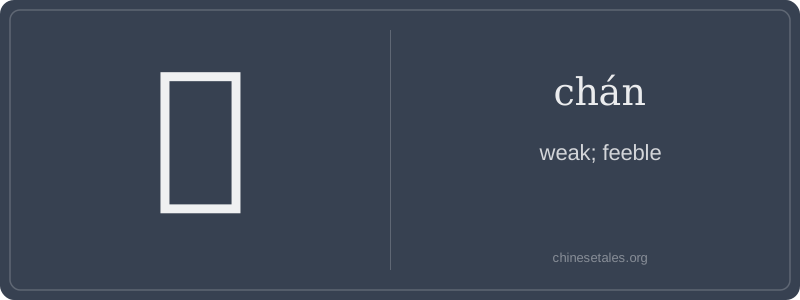
The earliest form of 孱 appears in bronze inscriptions as two stacked ‘child’ radicals (子子) beneath a roof-like top (宀), suggesting sheltered, underdeveloped youth — a visual metaphor for immaturity and lack of strength. Over time, the top simplified into the modern ‘two dots + horizontal stroke’ (), while the dual 子 radicals fused into one 子 on the left and a stylized ‘three strokes + vertical’ (尞) on the right — a phonetic component hinting at pronunciation. The 12 strokes encode this duality: 3 for the top dot-group, 3 for the left 子, and 6 for the right-side component, mirroring its layered meaning — weakness born of incompleteness.
By the Warring States period, 孱 appeared in texts like the *Zuo Zhuan*, describing states with ‘shallow virtue and 孱 strength’ — linking frailty to moral deficiency. In Tang poetry, it described delicate flowers or fading light, extending its sense beyond the physical to the ephemeral and fragile. Its visual doubling of 子 (child) reinforced the idea of arrested development: not just weak, but *unformed*, lacking the rootedness of maturity. Even today, its structure whispers: ‘a child beneath a roof — protected, yes, but never tested, never strong’.
Imagine a frail scholar in a Ming dynasty courtyard, leaning heavily on a bamboo cane, his robes hanging loosely — not from elegance, but exhaustion. That’s 孱 (chán): not just ‘weak’ in the physical sense, but carrying an almost poetic weight of constitutional fragility, chronic vulnerability, or inherited delicacy. It’s rarely used for temporary tiredness (that’s 累 lèi) or situational difficulty (that’s 难 nán). Instead, 孱 evokes something deep-rooted — like a plant with shallow roots, or a dynasty losing its moral fiber. You’ll hear it most often in literary or historical contexts, never in casual speech.
Grammatically, 孱 is almost always an adjective, and it *loves* reduplication: 孱孱 (chán chán) intensifies the frailty, like ‘feeble-feeble’ — think of trembling hands or a flickering candle flame. It can also appear in fixed classical compounds like 孱弱 (chán ruò), where 孱 modifies and deepens the meaning of 弱 (‘weak’) — together they mean ‘constitutionally feeble’, not just ‘weak’. Crucially, it’s never used predicatively without support: you wouldn’t say *‘He is 孱’*; you’d say *‘He is 孱弱’* or *‘His constitution is 孱’*. Learners often misapply it to modern stress or burnout — but that’s not 孱’s domain. This character belongs to the realm of essence, not episode.
Culturally, 孱 carries quiet stigma — it’s associated with the loss of yang energy, Confucian ideals of robust virtue, and even dynastic decline (e.g., late Qing critiques described the state as 孱弱). Its rarity in spoken Mandarin makes it a telltale sign of formal writing or historical analysis. Mistake it for a general synonym of ‘weak’, and you’ll sound oddly archaic — or unintentionally insulting, like calling someone’s lineage ‘frail’ instead of just ‘tired’.