孰
Character Story & Explanation
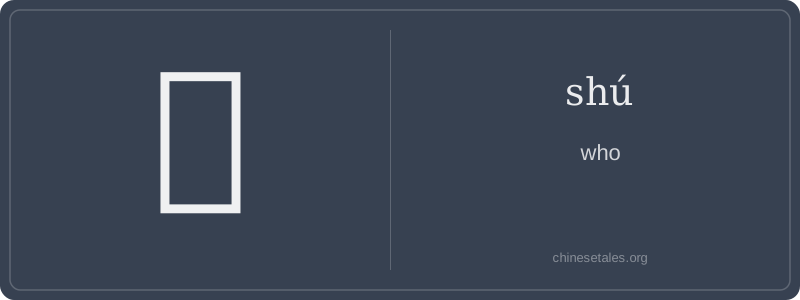
The earliest form of 孰 appears in Warring States bamboo slips and Han dynasty seals — not as a pictograph of a person, but as a clever phonosemantic compound. Its left side 子 (zǐ, 'child') is the semantic radical, hinting at human agency or status; its right side is a stylized variant of 熟 (shú, 'ripe, cooked, familiar'), originally written with 灬 (fire) beneath 享 (xiǎng, 'to enjoy offerings'). Over centuries, the fire radical simplified and merged, while the top part evolved into the distinctive 'three horizontal strokes + dot + vertical stroke' shape we see today — a visual echo of careful scrutiny, as if examining something thoroughly until it’s 'ripe' for judgment.
This evolution mirrors its semantic journey: from 熟 (shú, 'thoroughly known/ripe') → 孰 (shú, 'who is *so thoroughly known or qualified*?'). In the Mencius, 孰 appears repeatedly in dialogues testing moral discernment — e.g., '孰能无过?' ('Who among us can be without fault?') — where the question isn’t about identity, but about shared humanity and fallibility. The character’s visual density (11 strokes, compact yet intricate) mirrors its conceptual weight: it’s not just 'who', but 'who, after due consideration, truly merits this title?'
At first glance, 孰 (shú) looks like a formal, almost archaic 'who' — and it is. But don’t mistake its rarity for irrelevance: this character breathes with classical elegance and carries the weight of deliberation. Unlike the everyday 谁 (shéi/shuí), 孰 isn’t used in casual questions like 'Who’s there?' Instead, it appears in contexts demanding comparison, judgment, or rhetorical gravity — think 'who among these is more worthy?', 'who indeed can claim mastery?', or 'who dares oppose this truth?'. It’s less about identifying a person and more about weighing moral, intellectual, or hierarchical standing.
Grammatically, 孰 functions as an interrogative pronoun, but almost always in balanced, parallel structures — especially in classical Chinese and literary modern prose. You’ll find it paired with 与 (yǔ, 'and/with'), 如 (rú, 'as'), or 为 (wéi, 'to be') to form elegant comparative phrases like 孰与…? ('compared to…, who is superior?') or 孰为…? ('who, then, is…?'). Learners often misapply it like a direct substitute for 谁 — resulting in sentences that sound oddly solemn or even comically inflated, like asking your roommate '孰在厨房?' instead of '谁在厨房?'
Culturally, 孰 reflects China’s deep-rooted tradition of relational thinking: identity isn’t isolated — it’s defined *in contrast*. The character doesn’t ask 'who?' in a vacuum; it asks 'who, *relative to whom*?' — echoing Confucian emphasis on roles, hierarchy, and contextual virtue. Its absence from HSK isn’t because it’s obsolete, but because it lives in essays, debates, historical dramas, and political rhetoric — where precision of judgment matters more than speed of speech.