孭
Character Story & Explanation
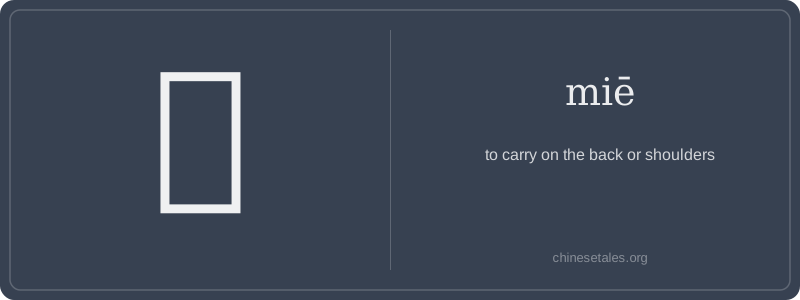
The earliest form of 孭 appears in late Warring States bamboo slips and Han dynasty seals — not as a pictograph, but as a semantic-phonetic compound. Its left side, 亠 (tóu), is a variant roof radical hinting at 'covering' or 'support from above'; the right side, 少 (shǎo), originally depicted a small hand or a bent figure, later evolving to suggest 'smallness' or 'reduction' — together, they conjure an image of someone lowering themselves slightly to lift another onto their back, shoulders forming a sheltering 'roof' over the person being carried. Over centuries, the top stroke simplified, and 少 lost its dotted 'dot' in clerical script, crystallizing into today’s clean, compact form.
This character’s meaning deepened alongside Confucian ideals of filial devotion and communal support. In Tang dynasty poetry, 孭 appears in lines describing sons carrying aging parents during wartime evacuations — not as duty, but as embodied loyalty. The shape itself — low and grounded, with no upward strokes — visually mirrors its semantic weight: it never implies lifting *upward* like 举 (jǔ), but rather *bearing* — horizontal, steady, intimate. Its rarity today isn’t decline, but preservation: 孭 survives in oral traditions across Fujian and Guangdong, where elders still say 孭孙儿 (miē sūn’ér) — 'shoulder-carrying one’s grandson' — as a term of proud, tactile affection.
At first glance, 孭 (miē) feels like a quiet, almost forgotten verb — it means 'to carry on the back or shoulders', but not in the casual way we say 'carry a bag'. It evokes effort, intimacy, and care: think of a parent hoisting a sleepy child, a farmer bearing heavy grain sacks, or an elder helping another up a mountain path. In Chinese, this isn’t just physical motion — it’s a gesture loaded with responsibility and tenderness, often implying voluntary, protective burden-bearing.
Grammatically, 孭 is a transitive verb that usually appears in compound verbs (like 孭起 or 孭着) or in literary/dialectal narrative. You won’t find it in daily Mandarin headlines or HSK textbooks — it’s more at home in regional storytelling, classical poetry, or descriptive writing. Learners rarely encounter it alone; instead, they’ll see it in phrases like 孭着孩子上山 (carrying the child up the mountain), where the ‘-zhe’ particle emphasizes continuity and physical presence — not abstract 'carrying' but embodied, shoulder-level labor.
Culturally, 孭 reveals how Chinese language encodes kinesthetic empathy: many verbs for carrying (背 bēi, 拿 ná, 提 tí) specify *how* weight moves through the body — back, hand, arm — making posture and intention grammatically visible. A common mistake? Assuming 孭 works like 背 (bēi). But while 背 covers general 'carrying on back', 孭 adds texture: grit, warmth, duration, even humility. It’s the difference between 'I carried the box' and 'I bore my sister up the stairs, her head resting against my neck.'