孬
Character Story & Explanation
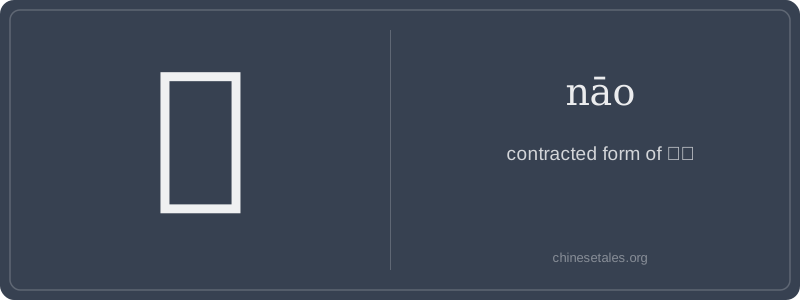
The character 孬 has no oracle bone or bronze script ancestry—it’s a latecomer, born during the Ming–Qing transition as a cursive shorthand for the phrase 不好. Its shape is a brilliant stroke-swap hack: take the top of 不 (bù)—the 'dot-and-stroke' radical 弗 without the vertical—and slap it over 子 (zǐ, 'child'), turning the child radical into a visual anchor while the borrowed top becomes a 'negation crown'. The 10 strokes aren’t arbitrary: 4 for the top component (a stylized, squashed 不), and 6 for 子—mirroring the phonetic rhythm of 'nāo' (a nasalized, drawn-out 'no'). Over centuries, scribes kept simplifying until the fusion felt inevitable.
This wasn’t scholarly invention—it bubbled up from theater scripts and vernacular novels like The Scholars, where characters spoke like real people. By the Qing dynasty, 孬 appeared in Beijing opera libretti as stage directions for actors to deliver lines with a shrug and a grunt. Its meaning never strayed far from 'no good'—but the visual pun stuck: a 'child' (子) under negation became the ultimate shorthand for 'not okay'. Even today, its shape whispers its origin: a compressed 'no' sitting on a 'kid'—as if saying, 'This whole situation? Nah. Not happening.'
Let’s cut through the confusion: 孬 (nāo) isn’t a standalone word with deep philosophical weight—it’s a colloquial contraction of 不好 (bù hǎo), meaning 'not good' or 'bad', used almost exclusively in Northern Mandarin dialects (especially Beijing, Hebei, and Tianjin). Think of it as Chinese slang’s answer to 'naw' or 'nah'—short, dismissive, and dripping with attitude. It carries zero formal register: you’ll never see it in news reports or textbooks, but you *will* hear it in street banter, sitcoms, or when your grumpy uncle refuses dessert ('Nāo!').
Grammatically, it functions like an interjection or sentence-final particle—not an adjective. You wouldn’t say 'this food is nāo'; you’d blurt 'Nāo!' alone to reject something outright, or tag it onto a phrase like 'Tài nāo le!' (Too bad!/No way!). Crucially, it’s *never* written in formal contexts; even native speakers often hesitate before typing it—because yes, it’s literally 'not good' squished into one character, and its visual form hints at that compression.
Culturally, 孬 is linguistic rebellion disguised as laziness: it’s the written fossil of rapid speech erosion. Learners’ biggest mistake? Assuming it’s interchangeable with 不好 or thinking it’s neutral—nope! It’s emphatically informal and mildly sarcastic or resigned. Also, don’t confuse it with 傻 (shǎ, 'stupid')—they sound similar but carry wildly different tones. And remember: if your textbook doesn’t list it, that’s intentional. This character lives in the spoken world, not the classroom.