孨
Character Story & Explanation
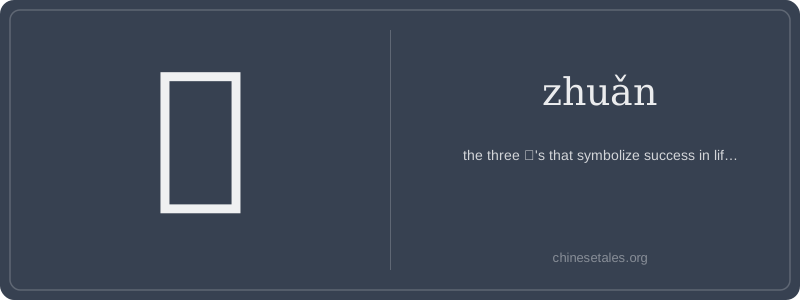
Forget oracle bones — 孨 has no ancient pedigree. It emerged organically online around 2015–2016, born from keyboard repetition: users typing 子 repeatedly to emphasize accumulation (‘child child child’) eventually stylized it into a single stacked glyph. Its nine strokes are simply three identical 子 radicals (each with 3 strokes) aligned vertically — no stroke fusion, no historical calligraphic evolution. There’s no seal script version, no Kangxi Dictionary entry. It’s digital folk etymology at its purest: a visual pun made real through collective typing habits and meme logic.
The meaning crystallized fast: each 子 came to represent one coveted adult milestone — not biological children, but homophonic stand-ins for ‘house’ (fángzi), ‘car’ (chēzi), and ‘wife’ (lǎopó zǐ, shortened jocularly to ‘zǐ’). By stacking them, netizens created a compact, tongue-in-cheek ‘success checklist’. Though absent from classical texts, its spirit echoes older idioms like ‘成家立业’ (establish family and career), just stripped of Confucian gravity and wrapped in Gen-Z irony. The stacked form visually screams ‘overload’ — three times the pressure, three times the exhaustion — making the character itself a silent protest in pixelated ink.
Let’s be real: 孨 isn’t in any textbook — and that’s exactly why it’s fascinating. It’s a modern internet-born character, not an ancient one, and its meaning isn’t carved in bronze but cooked up in WeChat group chats and Bilibili comment sections. Visually, it’s three 子 (zǐ, 'child') stacked vertically — no hidden oracle bone mystery here. But don’t dismiss it as a joke: it carries real cultural weight as shorthand for the ‘three pillars of success’ in contemporary Chinese urban life: a house (fángzi), a car (chēzi), and a wife (lǎopó zǐ, colloquially reduced to just ‘zǐ’ in this playful, ironic triad). It’s never used alone in formal writing; you’ll only see it in memes, social media posts, or sarcastic commentary on societal pressure.
Grammatically, 孨 functions purely as a noun — always in informal, often self-deprecating or humorous contexts. You won’t conjugate it or add particles like 的 or 了. It appears in phrases like ‘还没搞定孨呢’ (‘Haven’t secured the three zǐ yet’) — where 孨 stands in for the entire package. Learners sometimes mistakenly treat it like a classical character and try to use it in essays or speeches — big red flag! It’s strictly vernacular, zero prestige, and zero tolerance for seriousness.
Culturally, 孨 is linguistic satire with teeth: it mirrors millennial frustration with China’s skyrocketing cost of living and rigid expectations around marriage and homeownership. The irony? Each 子 literally means ‘child’, yet the ‘three children’ here are *not* offspring — they’re material milestones. That dissonance is the whole point. A common mistake is misreading it as zǐ (the sound of 子) instead of zhuǎn — yes, the pronunciation was deliberately chosen to sound like ‘turn’ or ‘spin’, hinting at the dizzying, cyclical pressure to ‘turn’ your life around by acquiring these three things.