孟
Character Story & Explanation
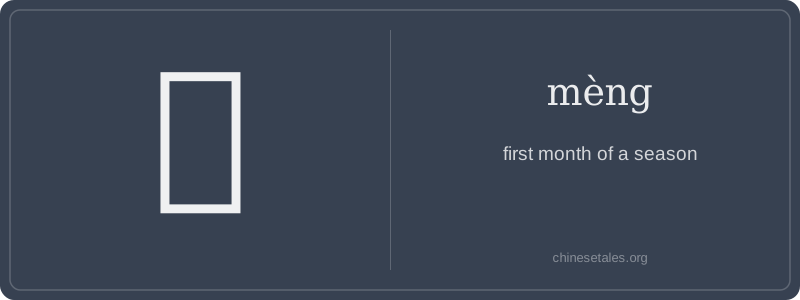
The earliest form of 孟 appears in bronze inscriptions as a compound: top half resembling 艸 (cǎo, grass/plants), bottom half the radical 子 (child). But this wasn’t about botany — scholars now believe the upper part was a stylized variant of 玄 (xuán, deep black/dark), representing the ‘primordial beginning’, later simplified into the two horizontal strokes and dot we see today. Over centuries, the top evolved from intricate curves into the clean, open shape of 亡 (wáng) — though it shares no etymological link with that character. The 子 radical remained constant, anchoring the idea of ‘originating generation’ — not birth order per se, but temporal primacy within a cyclical system.
This visual logic aligned perfectly with Zhou dynasty cosmology: seasons weren’t linear but generative cycles, and 孟 marked the moment when Heaven’s vital force (qi) first stirred anew. In the *Analects*, Confucius references 孟夏 to denote ethical timing — ‘acting in early summer’ meant acting at the right moment of growth. Later, Mencius (Mèngzǐ) adopted the character in his honorific name precisely because his philosophy emphasized moral beginnings and innate human sprouts (like 孟春’s first buds). So 孟 isn’t just ‘first’ — it’s ‘first with potential’, ‘first that matters’.
At first glance, 孟 (mèng) feels like a quiet, scholarly character — not flashy, but deeply rooted in Chinese timekeeping and hierarchy. Its core meaning is 'the first month of a season' (e.g., 孟春 mèng chūn = early spring), evoking freshness, precedence, and subtle authority — like the first green shoot pushing through frost. It’s never used alone in speech; it only appears in classical or literary compounds, always paired with seasonal or ordinal terms. Think of it as a time-labeling prefix — elegant, precise, and slightly formal.
Grammatically, 孟 functions exclusively as an attributive adjective before nouns: 孟夏 (mèng xià, early summer), 孟秋 (mèng qiū, early autumn). You’ll never say *‘wǒ zài mèng’* — it has no standalone verb or pronoun use. Learners sometimes misread it as ‘Meng’ (a surname) and overgeneralize — but as a surname, it’s pronounced mèng *only* when referring to Mencius (Mengzi); otherwise, surnames can vary regionally. Crucially, 孟 is *not* interchangeable with 初 (chū, 'first') — while both mean 'first', 初 is neutral and modern (初一 chū yī = 1st day of lunar month), whereas 孟 is archaic-seasonal and carries cosmological weight.
Culturally, 孟 reflects ancient China’s tripartite seasonal rhythm: each season had three months — 孟 (first), 仲 (zhòng, middle), and 季 (jì, last). This system appears in texts like the *Book of Rites* and shaped imperial calendars. Modern learners rarely encounter it outside idioms, poetry, or historical contexts — so seeing it in a weather report or essay signals literary sophistication. A common mistake? Confusing its radical 子 (child) with its function — it doesn’t mean 'firstborn' here (that’s 长子 zhǎngzǐ); the 子 radical hints at order and generation, not literal offspring.