孛
Character Story & Explanation
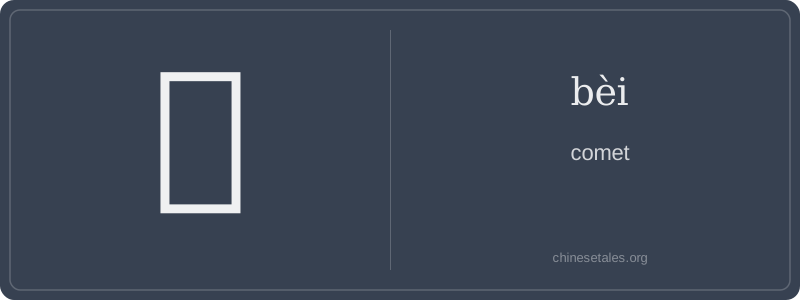
The earliest form of 孛 appears on Warring States bamboo slips as a stylized pictograph: a central ‘star’ element (evolving into the 子 radical) topped by three jagged, upward-sweeping strokes representing streaming, bushy light — like fiery hair radiating from a celestial body. Over centuries, the top simplified from wavy lines to three parallel slanted strokes (彡-like), while the bottom solidified into 子 (originally a pictograph of a baby, later repurposed for ‘small celestial body’ in star-related characters). By the Han dynasty clerical script, the seven-stroke structure was locked in: three strokes above, four below — a perfect visual metaphor for a star with a chaotic, radiant tail.
This ‘bushy star’ meaning persisted unbroken for over two millennia. In the Zuo Zhuan, 孛 appears in ominous records like ‘孛见于东’ (‘A comet appeared in the east’), signaling political crisis. Its phonetic component is silent — unlike most phono-semantic compounds, 孛 has no surviving sound clue, making it a rare ‘meaning-only’ character. Even today, when poets invoke 孛星, they’re not describing orbital mechanics — they’re echoing the tremor of ancient astronomers watching heaven unravel order.
At first glance, 孛 (bèi) feels like a cosmic whisper — it’s not just ‘comet’ in the astronomical sense, but carries the ancient weight of celestial omen: in classical Chinese thought, comets were ‘bushy stars’ (hence the radical 子 ‘child/star’ + the top component resembling disheveled hair or streaming light), portending upheaval, dynastic change, or divine warning. You’ll almost never hear it in daily speech — it’s literary, historical, and poetic, appearing in chronicles like the Records of the Grand Historian or Tang dynasty poetry, never in weather reports or science textbooks.
Grammatically, 孛 functions as a noun only — no verbs, adjectives, or compounds with grammatical particles attached to it directly. It doesn’t take aspect markers like 了 or 着, nor does it combine freely like 星 (xīng, ‘star’) does. Instead, it appears in fixed, elevated phrases: 孛星 (bèi xīng, ‘comet’) or in names like 孛孛 (Bèibèi, an archaic reduplication evoking flickering motion). Learners sometimes misread it as bèi (like 被) or try to use it as a verb — a classic trap, since its sound and shape echo more common characters, but its usage is strictly fossilized and ceremonial.
Culturally, 孛 is a linguistic time capsule: it preserves the pre-scientific cosmology where heaven spoke through luminous anomalies. Modern readers may confuse it with 备 or 倍 due to similar pronunciation, but those have nothing to do with astronomy — they’re about preparation and multiplication. And crucially: 孛 is *never* used alone in modern Mandarin; it always appears in compounds or classical allusions. If you write ‘今天看到孛’ — without 孟 or 星 — native speakers will pause, blink, and ask, ‘Which comet? What text are you quoting?’