婶
Character Story & Explanation
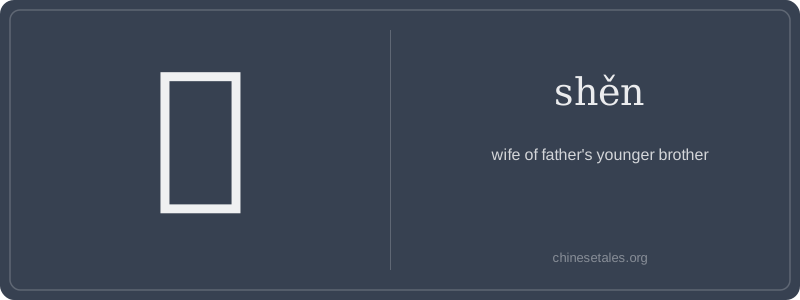
The earliest form of 婶 doesn’t appear in oracle bones — it’s a later creation, emerging around the Han dynasty as kinship terminology became codified. Visually, it combines 女 (nǚ, ‘woman’) on the left — a classic radical for female-related terms — and 申 (shēn), on the right, which originally depicted lightning bolts (a pictograph of zigzag lines) and later came to mean ‘to declare’ or ‘to extend.’ In 婶, 申 serves phonetically (shěn shares its sound with 申), but also subtly suggests ‘extension’ — her role extends the family line through marriage, linking two households. Stroke-by-stroke: start with the three-stroke 女 radical (dot, hook, sweep), then build 申: vertical stroke, then the distinctive ‘lightning’ enclosure — top horizontal, left vertical, then the winding inner strokes (丨、、一) — total 11 strokes, balanced and grounded.
Historically, 婶 first appears in Tang-era texts like the *Yongle Dadian* glossaries, always in kinship charts emphasizing Confucian ‘five relationships.’ Unlike classical terms like 妣 (bǐ, deceased mother), 婶 is resolutely *living* and *present-tense* — a warm, active presence in daily life. Its visual pairing of ‘woman’ + ‘declaration’ quietly mirrors its social function: she is formally declared into the family through marriage, yet instantly embraced as kin. No ancient poem calls her by name — but every Chinese child’s first dumpling-making lesson happens under her watchful, flour-dusted hands.
Imagine you’re at a bustling family reunion in Guangzhou — aunties bustling with steamed buns, uncles swapping stories, and your dad suddenly gestures toward a woman in a floral qipao: 'Shěnshu,’ he says warmly. That’s 婶 (shěn): not just ‘aunt,’ but specifically the wife of your father’s younger brother. It’s a term dripping with intimacy and hierarchy — respectful yet affectionate, used only within the paternal uncle’s branch of the family. You’d never call your mother’s sister ‘shěn’ (she’s 姨 yí); that distinction matters deeply.
Grammatically, 婶 is almost always paired with shu (叔) — as in 婶婶 (shěnshen), the reduplicated, tender form meaning ‘Auntie.’ You’ll hear it in direct address ('Shěnshen, nǐ hǎo!') or possessive phrases ('wǒ shěnshen de cài'), but never standalone as a noun without context — unlike English ‘aunt,’ which can float freely. Learners often overgeneralize it to any older female relative; that’s like calling your mom’s best friend ‘Mom’ at Thanksgiving — culturally jarring.
Culturally, 婶 carries subtle warmth and informality: it implies closeness, even familiarity — especially in southern dialects where it may soften into ‘shēn’ or blend with local honorifics. Interestingly, while not HSK-listed, it appears constantly in spoken Mandarin, TV dramas, and WeChat family group chats. The biggest pitfall? Forgetting tone: shēn (1st) means ‘deep,’ shèn (4th) is ‘what/which,’ but shěn (3rd) is *only* this aunt — so mispronouncing it risks sounding like you’re asking ‘Which aunt?’ mid-introduction!