嬲
Character Story & Explanation
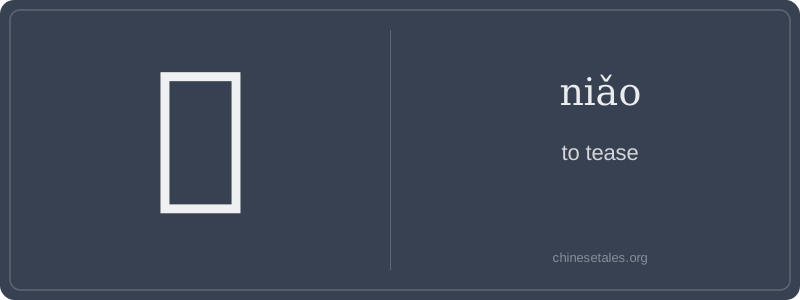
The character 嬲 is a latecomer — it doesn’t appear in oracle bone or bronze inscriptions. Its earliest confirmed use is in Song dynasty dictionaries and Ming-Qing vernacular fiction. Visually, it’s a brilliant piece of folk etymology: built from three components — 女 (nǚ, 'woman') flanked by two 男 (nán, 'man') radicals — though 男 itself isn’t used as a standalone radical here. Instead, the left and right sides are stylized variants of 男 (with the 'field' 田 simplified to 田-like shapes and the 'strength' 力 retained), forming a symmetrical, almost comical frame around the central 女. Over centuries, clerical and regular script smoothed the strokes, turning angular force into fluid balance — 17 strokes total, each contributing to its dense, bustling energy.
Its meaning evolved from early slang for 'to harass' or 'to pester' — likely rooted in regional humor about gender dynamics — into today’s softer, more affectionate 'to tease'. The classical novel Water Margin uses related forms in dialogue to depict boisterous camaraderie, while modern internet users revived 嬲 as a meme-worthy alternative to boring synonyms like 取笑 or 开玩笑 — precisely because its outrageous shape *looks* like teasing: busy, repetitive, impossible to ignore.
At its heart, 嬲 (niǎo) captures a very Chinese kind of teasing — playful, persistent, and often lighthearted but with an edge of gentle provocation. It’s not harsh mockery or bullying; it’s the wink-and-nudge banter between close friends, the teasing that tests affection without crossing a line. Think of siblings needling each other, or a grandparent playfully scolding a grandchild who’s being cheeky — the tone matters more than the words.
Grammatically, 嬲 is almost always used as a verb in colloquial speech or informal writing, often in reduplicated form (嬲嬲) for emphasis, or paired with aspect particles like 了 or 着. You’ll rarely see it in formal documents or news, and it’s nearly absent from textbooks — yet it pops up constantly in online chats, regional dialects (especially Guangdong and Fujian), and spoken Cantonese-influenced Mandarin. A sentence like '他老嬲我' (tā lǎo niǎo wǒ) means 'He’s always teasing me' — where 老 adds habitual flavor, and 嬲 carries the active, rhythmic feel of poking fun.
Culturally, this character reflects how Chinese communication values relational nuance: teasing can affirm intimacy, not undermine it. Learners often misread it as vulgar due to its visual intensity (three 'male' radicals!), or overuse it in formal contexts — a classic faux pas. Also, many assume it’s purely Cantonese, but while it’s more common there, Mandarin speakers (especially younger netizens) adopt it for ironic or emphatic effect — revealing how digital culture breathes new life into rare characters.