嬬
Character Story & Explanation
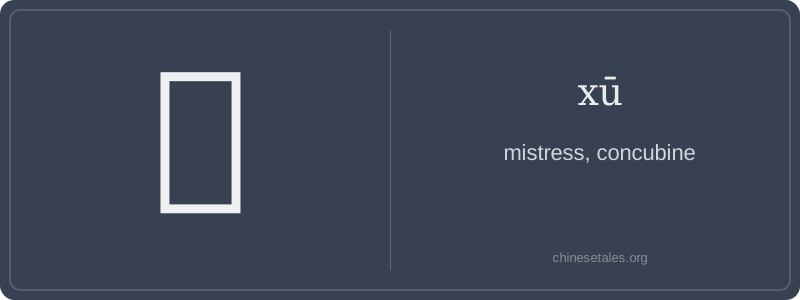
The earliest attested form of 嬬 appears in Han dynasty clerical script, not oracle bones — because it wasn’t an ancient pictograph at all. It’s a phono-semantic compound invented later: the left side 女 (nǚ, ‘woman’) signals category, while the right side 谷 (gǔ, ‘valley’) was borrowed purely for its sound value, approximating *xū in Old Chinese. Visually, the modern form stabilizes around the Tang dynasty: 女 takes its standard three-stroke left radical shape, while 谷 evolves from a pictograph of grains in a ravine into its simplified, six-stroke form — no longer evoking agriculture, but serving as a reliable phonetic anchor.
This character’s meaning crystallized during the Zhou and Han dynasties, when concubinage became codified in rites like the ‘Book of Rites’ (Lǐjì), where 嬬 specifically denoted a woman formally received through ritual gift exchange (纳币, nà bì). Unlike the more generic 妾 (qiè), 嬬 carried elevated connotations — sometimes used for concubines of high-ranking officials or imperial princes. Its visual calm — a woman beside a valley — belies its loaded function: not romance, but social engineering. You’ll find it in Sima Qian’s ‘Records of the Grand Historian’ describing royal marriages, always paired with verbs like 迎 (yíng, ‘to welcome ceremonially’) or 立 (lì, ‘to install’).
At first glance, 嬬 (xū) feels like a relic — it’s not in the HSK, rarely appears in modern speech, and carries the quiet gravity of imperial China’s household hierarchies. Its core meaning is ‘concubine’ or ‘mistress’, but crucially, not in the casual or romantic sense Western learners might assume. In classical usage, it denotes a formally recognized secondary wife within a polygynous marriage structure — one with documented status, ritual duties, and often lineage responsibilities. Think less ‘romantic partner’ and more ‘institutional role’: she managed inner quarters, raised children (including those of the principal wife), and held rank — sometimes even inheriting property.
Grammatically, 嬬 almost never stands alone in modern writing; it appears only in compound nouns or historical/literary contexts. You’ll never say ‘she is a 嬬’ — instead, you’ll encounter it in terms like 妾室 (qièshì, ‘concubine chamber’) or as part of classical phrases like ‘纳妾’ (nà qiè, ‘to take a concubine’). Learners mistakenly try to use it like a generic word for ‘girlfriend’ — a serious faux pas that would sound archaic, inappropriate, or even offensive in contemporary settings.
Culturally, 嬬 reflects Confucian kinship architecture: it implies consent, formality, and social sanction — unlike the pejorative term 外室 (wàishì, ‘outside room’), which suggests secrecy and illegitimacy. Modern readers may misread it as related to 女 (nǚ, ‘woman’) alone, but its right-side component 谷 (gǔ, ‘valley’) is actually phonetic — not semantic — a clue that this character was designed for sound, not pictorial logic. That’s why mistaking it for 奚 (xī) or 姐 (jiě) leads to real confusion: tone and context are everything here.