嬦
Character Story & Explanation
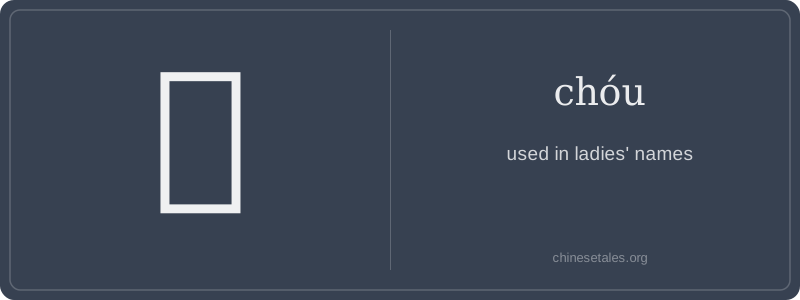
The character 嬦 first appeared in late imperial times — not in oracle bone or bronze inscriptions (it’s too young for that!), but in Song- and Ming-dynasty name registers and calligraphic anthologies. Its form is a deliberate fusion: the left radical 女 (nǚ, 'woman') anchors its gendered identity, while the right component is a stylized variant of 誘 (yòu, 'to entice') — but simplified and aestheticized over centuries into the elegant, flowing shape we see today. Early manuscripts show the right side with more angular strokes, gradually softening into curved, balanced lines meant to evoke composure and dignity — mirroring the Confucian ideal of the cultivated woman.
Historically, 嬦 never entered classical texts as a semantic unit; you won’t find it in the Analects or Tang poetry. Instead, it flourished in genealogical records and marriage contracts, where naming reflected family aspirations. Its visual rhythm — three horizontal strokes in the 女 radical, then a graceful descending curve in the right — was prized for calligraphic beauty. By the Qing dynasty, it had become a subtle marker of elite literacy: families choosing 嬦 signaled both literary awareness and adherence to refined naming conventions — less about meaning, more about resonance, tone, and brushstroke elegance.
Think of 嬦 like the Chinese equivalent of 'Evelyn' or 'Seraphina' in English — a character that doesn’t mean anything concrete on its own, but carries a distinct aura: refined, gentle, and unmistakably feminine. It’s not a verb, not a noun with independent meaning, and certainly not a grammatical particle — it’s purely ornamental, reserved almost exclusively for women’s given names. You’ll never see it in a dictionary definition outside of 'used in female names', and you’ll never hear it in isolation — it only lives nestled between other characters, like in 林婌嬦 (Lín Shúchóu) or 陈姈嬦 (Chén Língchóu).
Grammatically, 嬦 functions as a name suffix — much like how '-lyn' or '-elle' work in English names (e.g., 'Brookelyn', 'Gabrielle'). It never takes modifiers, never appears in compounds with verbs or adjectives, and never stands alone in speech or writing. Learners sometimes mistakenly try to use it as a standalone word ('She is 嬦') or confuse it with actual nouns — but no native speaker would ever do that. Its pinyin chóu rhymes with 'show', which helps signal its phonetic role over semantic function.
Culturally, 嬦 reflects a deep-rooted tradition of naming aesthetics in Chinese: characters selected not for utility but for tonal harmony, visual elegance, and auspicious connotations. It’s often paired with characters suggesting grace (婌 shú), purity (姈 líng), or tranquility (嫕 yìn). A common mistake is overgeneralizing its usage — it’s *not* used for all female names, only those deliberately crafted with classical refinement. And crucially: it’s absent from all official language benchmarks (HSK, GB2312), so encountering it means you’ve stepped into the poetic, personal realm of real-life naming — not textbook Chinese.