嬷
Character Story & Explanation
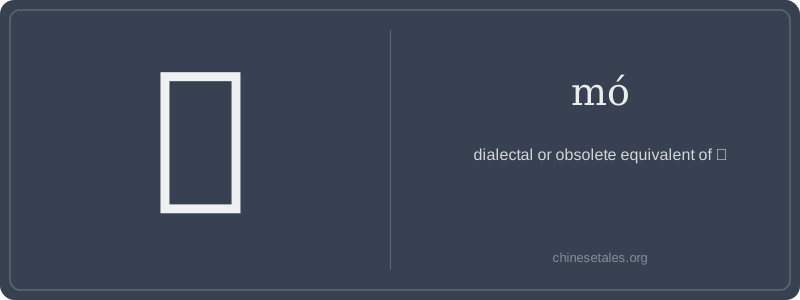
嬷 began as a late Han dynasty innovation — not in oracle bones, but in clerical script (lìshū), where scribes fused 女 (nǚ, 'woman') with 麻 (má, 'hemp') as a phonetic-semantic compound. Visually, it’s elegant but precise: the left-side 女 radical anchors its feminine meaning, while the right side 麻 (11 strokes) provides both sound (mó, close to má but with tone shift) and subtle semantic layering — hemp was associated with domestic labor, weaving, and nurturing (think: hemp cloth swaddling babies). Over centuries, the clerical 麻 simplified into the modern form: the two 'linen' components (two 丷 shapes) stacked atop 广, then beneath the dot-and-hook of the final stroke — totaling 17 strokes, a number echoing the 'fullness' of maternal care.
The meaning solidified during the Ming-Qing era, appearing in vernacular novels like Dream of the Red Chamber, where maids and wet nurses were respectfully called 'mó mó' — not just 'mother,' but 'motherly caregiver.' This dual role (biological mom + nurturing elder woman) explains why 嬷 often implies wisdom, gentleness, and authority wrapped in warmth. Its visual density — all those interlocking strokes — mirrors how maternal roles entangle duty, love, and quiet strength. Even today, seeing 嬷 on the page feels like touching embroidered hemp cloth: textured, resilient, deeply human.
Think of 嬷 as the warm, folksy, slightly old-fashioned cousin of 妈 — both mean 'mom,' but 嬷 carries the cozy weight of dialect (especially Northern Mandarin and Beijing opera slang) and vintage charm. It’s not used in formal writing or modern standard Chinese, but pops up in storytelling, regional speech, and affectionate nicknames — like calling your grandma 'Nǎi mó' instead of 'Nǎi mā.' The character radiates intimacy and rustic familiarity, almost like hearing a lullaby hummed by your great-aunt in a courtyard alley.
Grammatically, it functions identically to 妈: as a standalone noun (e.g., 'Mó mó!' for 'Mom!'), often reduplicated for tenderness ('mó mó'), or prefixed with kinship terms ('nǎi mó', 'gū mó'). Crucially, it’s never used in formal address, official documents, or textbooks — which is why it’s absent from the HSK list. Learners sometimes mistakenly use it in essays or emails expecting 'standard' respect; instead, they’ll sound like a character from a 1930s Peking teahouse drama. Also beware: while 嬷 is *only* pronounced mó in this maternal sense, the same written form appears in the rare literary variant of 妈 (as in classical poetry where 嬷 was once an alternate orthography), though that usage is nearly extinct today.
Culturally, 嬷 evokes oral tradition — it’s the word whispered in folk tales, sung in nursery rhymes, and preserved in regional opera scripts. Its survival isn’t due to prestige, but to emotional resonance: it sounds rounder, softer, more nurturing than 妈 — almost onomatopoeic, like a gentle 'mō-mō' coo. A common pitfall? Assuming it’s interchangeable with 妈 anywhere — nope! Using 嬷 in a job interview or WeChat message to your boss would raise eyebrows (and maybe a smile… but not the right kind).