嫱
Character Story & Explanation
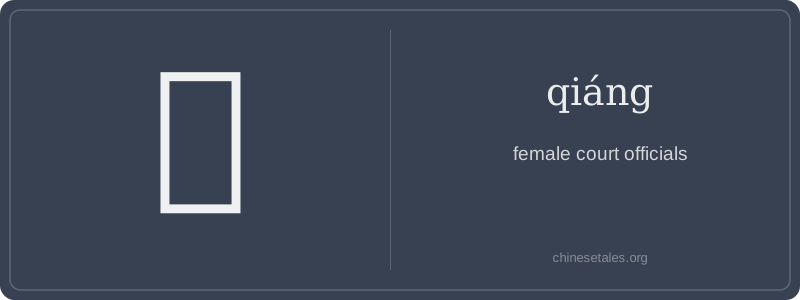
The earliest form of 嫱 doesn’t survive in oracle bones, but its bronze script ancestor reveals its drama: a woman (女) beside a stylized figure holding a ceremonial staff or banner — possibly representing tribal envoys presenting noblewomen for court service. Over centuries, the right-hand component evolved into 羌, originally depicting a person with horns (a Qiang tribal marker), later simplified and fused with the female radical. By the Han dynasty, the structure stabilized: 女 on the left, 羌 on the right — 14 strokes total, each stroke deliberate: the three dots in 羌’s top (⺶) suggest ritual sprinkling, the vertical stroke below echoes a standing figure, and the final horizontal sweep grounds her dignity.
This visual fusion — woman + Qiang — reflects historical reality: during the Western Han, elite Qiang families sent daughters to serve in Chang’an’s inner court, where they became famed for grace and erudition. The character crystallized in texts like the Hanshu (Book of Han), where it appears only in phrases honoring Zhaojun and Wang Qiang — two paragons whose names became synonymous. Crucially, 嫱 was never bureaucratic; it was poetic shorthand for 'court lady who embodies cultural harmony through beauty and restraint' — a linguistic jewel polished by centuries of verse.
Think of 嫱 (qiáng) not as a generic 'female official' but as a shimmering, almost mythic title — like calling someone 'Lady-in-Waiting of the Vermilion Chamber.' It’s deeply literary, rarely used in speech or modern admin; you’ll find it almost exclusively in classical poetry, historical novels, or formal allusions to imperial court women. Its core feel is elegant, restrained, and faintly melancholic — evoking beauty bound by ritual. The character itself breathes quiet authority: the 女 (nǚ) radical grounds it in femininity, while the right side 羌 (qiāng) isn’t just phonetic — it subtly echoes ancient Qiang tribal names, hinting at how early court ladies were sometimes drawn from frontier noble families.
Grammatically, 嫱 never stands alone. It only appears in fixed, poetic compounds like 昭君嫱 — always paired with another legendary beauty (e.g., 王昭君), forming a rhetorical duo meaning 'the most exalted court beauties.' You won’t say 'she is a 嫱'; instead, you’d write '昭君嫱并称' (Zhāo Jūn qiáng bìng chēng) — 'Zhaojun and Qiang are jointly acclaimed.' Learners often mistakenly treat it as a standalone noun like 'teacher' or 'doctor,' but it functions more like an honorific suffix — archaic, untranslatable without context, and utterly dependent on literary framing.
Culturally, 嫱 carries the hush of palace corridors — not power, but presence. It’s tied to ideals of refined virtue, silent endurance, and aesthetic perfection. A common mistake? Confusing it with 樯 (qiáng, 'mast') or 强 (qiáng/qiǎng/qiāng, 'strong') — same sound, wildly different worlds. Also, don’t expect to hear it spoken aloud outside recited Tang poetry; even native speakers may pause to recall its meaning. Its rarity is part of its charm — like spotting a rare bird in a classical scroll.