嬗
Character Story & Explanation
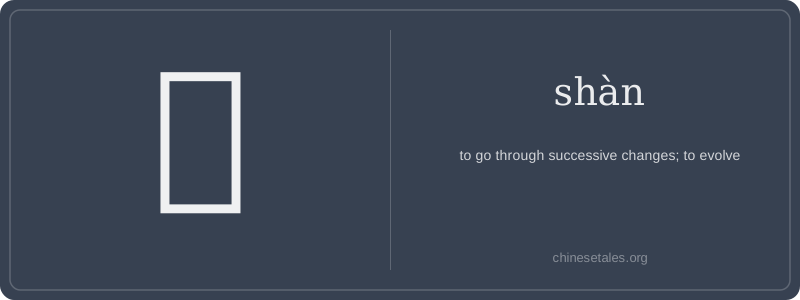
The earliest form of 嬗 appears in bronze inscriptions as a complex glyph combining 女 (nǚ, 'woman') with two stacked 十 (shí, 'ten') signs and a variant of 亶 (dǎn, meaning 'abundant, sincere'). Scholars believe this depicted a ritual: a woman presiding over cyclical offerings — ten grains, then ten silks — symbolizing orderly, recurring transformation in ancestral rites. Over centuries, the stacked 十s merged into 一 and 日, while 亶 simplified into 亶 → 亶 → 亶 (retaining its 'sincerity + abundance' connotation), and the whole structure settled into today’s 16-stroke form: 女 + 一 + 日 + 亶.
By the Warring States period, 嬗 appeared in texts like the Zhuangzi, describing the Daoist ideal of effortless change — '物之嬗也,若水之流' ('The transformation of things flows like water'). Its radical 女 isn’t about gender, but signals *nurturing agency*: change isn’t imposed, but cultivated, like a mother guiding growth. Even today, when scientists write about genetic 嬗變, they evoke this ancient sense — not mutation as accident, but evolution as inherent, dignified unfolding.
Think of 嬗 (shàn) as the quiet, elegant cousin of 'evolve' — not explosive transformation like 爆炸 (bàozhà), but slow, layered, almost ceremonial change: seasons turning, dynasties rising and falling, a caterpillar becoming a butterfly in silence. Its core feeling is *inevitable progression*, where each stage flows organically into the next — no force, just time and internal logic. You’ll rarely hear it in daily chat; it’s literary, formal, often found in essays, scientific discourse on development, or philosophical reflections.
Grammatically, 嬗 is almost always a verb — but unlike most Chinese verbs, it *never* takes aspect particles like 了 (le) or 过 (guo) directly after it. Instead, it appears in compound verbs (e.g., 演變, 蜕變) or as the head of a noun phrase: 'the process of 嬗' → 嬗變 (shànbiàn). You might say ‘科技的發展與社會的嬗變’ — notice how 嬗 here isn’t conjugated; it’s frozen in its elegant, unchanging form, mirroring the very concept it names.
Culturally, 嬗 carries the weight of classical cosmology — the idea that change isn’t random, but follows cosmic patterns (like the Yijing’s hexagrams). Learners often misread it as 善 (shàn, 'good') due to identical pronunciation and proximity in dictionaries — but confusing them turns 'social evolution' into 'social goodness', losing all nuance. Also, don’t try to use it alone in speech — it sounds archaic, even poetic, like saying 'verily' instead of 'really'.