嬎
Character Story & Explanation
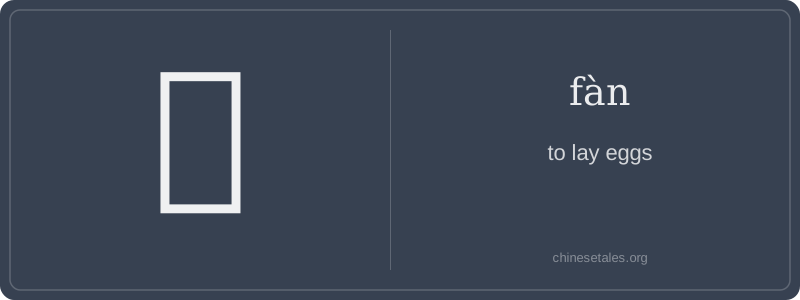
The character 嬎 has no oracle bone or bronze script ancestry — it’s a late, ingenious folk creation from the Ming–Qing period, born not in royal archives but in village courtyards. Its structure is brilliantly literal: the left radical 女 (nǚ, 'woman') doesn’t mean gender here — it’s a phonetic loan for the sound fàn (compare 婆 pó, 婆婆 pópo); the right side 卵 (luǎn, 'egg') is both semantic *and* visual — those three dots (⺈ + + 丶) evolved from stylized oval shapes representing eggs nestled in straw. Over centuries, scribes simplified the 卵 component, merging strokes until the modern form emerged — a woman-like figure cradling two rounded eggs.
Originally recorded in Qing-era vernacular novels like Strange Tales from a Chinese Studio (where a fox spirit ‘嬎金蛋’ as a metaphor for miraculous abundance), 嬎 quickly rooted itself in northern oral tradition as the go-to verb for hens performing their quiet, daily miracle. Its visual logic — female + egg — isn’t biological but poetic: it frames egg-laying as a nurturing, cyclical act, not mere biology. That’s why classical texts use 生卵 (shēng luǎn) or 下蛋, while 嬎 remains the warm, living word whispered over coop fences — a character that didn’t descend from heaven, but hatched from human observation.
Forget everything you thought you knew about egg-laying verbs — 嬎 (fàn) isn’t just ‘to lay eggs’; it’s the *only* native Chinese verb that exclusively and vividly describes hens (and sometimes ducks or geese) depositing eggs *in a nest*, with soft, quiet, rhythmic regularity. It carries a rustic, almost tender connotation — think of a backyard henhouse at dawn, not industrial poultry farms. Unlike generic verbs like 下蛋 (xià dàn), which is neutral and widely used, 嬎 is deeply dialectal (predominantly Northern Mandarin, especially Shandong, Hebei, and rural Beijing speech) and carries warm, colloquial, even affectionate weight — you’d say 这只老母鸡真能嬎 (zhè zhī lǎo mǔ jī zhēn néng fàn) to praise your hen like a hardworking aunt.
Grammatically, 嬎 is intransitive and rarely takes an object — you don’t ‘lay *an egg*’ with this verb; you simply 嬎. It often appears in reduplicated form (嬎嬎) for emphasis or habitual action, or paired with aspect particles like 了 (le) or 着 (zhe): 鸡又嬎了 (jī yòu fàn le) — 'The hen laid another one!' Learners mistakenly try to use it with objects (e.g., ×嬎一个蛋) or in formal writing — a dead giveaway of non-native speech. It also never applies to humans or machines: no one says ‘robot嬎蛋’ — that’s pure comedy.
Culturally, 嬎 evokes pre-modern agrarian intimacy: the sound fàn mimics the soft, contented cluck after laying, and its rarity in textbooks reflects how Mandarin standardization quietly sidelined many rich, earthy verbs in favor of more general terms. Native speakers often smile when they hear it — it smells of straw, warm nests, and grandmother’s stories. Mispronouncing it as fān (like 翻) or fàn (like 饭) is common, but the correct tone is fourth — sharp and decisive, like a hen giving a final satisfied peep.