嬉
Character Story & Explanation
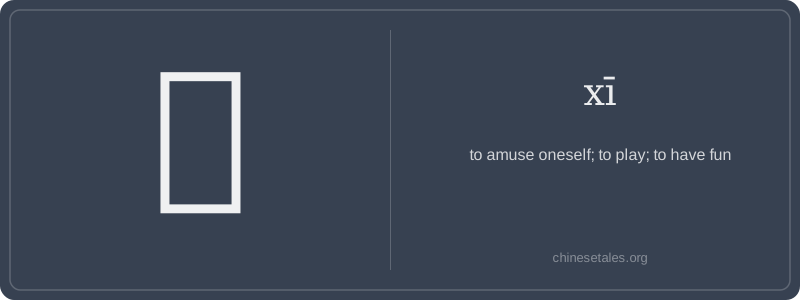
The earliest form of 嬉 appears in Warring States bamboo slips as a combination of 女 (nǚ, ‘woman’) and 喜 (xǐ, ‘joy’), but crucially — with an extra ‘mouth’ (口) component added to 喜. Oracle bone inscriptions don’t show it, but by the Qin seal script, it had crystallized into today’s structure: 女 on the left, and a modified 喜 (with the top ‘士’ simplified and the bottom ‘豆’ evolving into 口 + 欠) on the right. The 15 strokes encode this evolution: the woman’s graceful posture (女) frames the joyful, expressive face — mouth open in laughter, breath rising (欠), delight bubbling up.
This visual logic shaped its meaning: not mere activity, but *embodied, vocal, socially resonant mirth*. In the Zuo Zhuan, it appears describing courtiers ‘嬉于朝’ (xī yú cháo) — ‘playing merrily at court’ — where their wit and charm reinforced social bonds. By the Tang, poets like Li Bai used 嬉 to contrast carefree natural joy (e.g., fish 嬉 stream) against human constraint. Its enduring elegance lies in how the ‘woman’ radical doesn’t imply gendered action — rather, it anchors the character in relational, nurturing, and culturally refined expression.
At its heart, 嬉 isn’t just ‘to play’ — it’s *play with lightness, grace, and unselfconscious joy*. Unlike 玩 (wán), which is neutral and everyday (‘play a game’, ‘play with toys’), 嬉 carries poetic weight: it evokes laughter echoing in courtyards, children chasing butterflies in silk robes, or scholars teasing each other with wit — always elegant, never crude. You’ll rarely hear it in casual speech; it lives in literature, idioms, and formal description.
Grammatically, 嬉 is almost always transitive and appears in compound verbs like 嬉戏 (xī xì) or as the first element in literary phrases. It doesn’t take aspect markers (no 嬉了, 嬉过); instead, it’s often paired with classical particles like 而 (ér) — e.g., 嬉而忘食 (xī ér wàng shí, ‘play so joyfully one forgets to eat’). Learners mistakenly use it like 玩, but saying ‘我嬉电脑’ sounds like quoting a Tang dynasty poet mid-scroll — hilariously out of place.
Culturally, 嬉 reflects the Confucian appreciation for *play as cultivated expression*, not idle distraction. In classical texts, it describes virtuous leisure — the kind that refines character. Modern writers still reach for it when painting scenes of idyllic harmony: a grandmother 嬉孙 (xī sūn, ‘playing fondly with her grandchild’) isn’t just goofing around — she’s embodying tender, intergenerational warmth. Misusing it risks sounding archaic, ironic, or unintentionally theatrical.