嫬
Character Story & Explanation
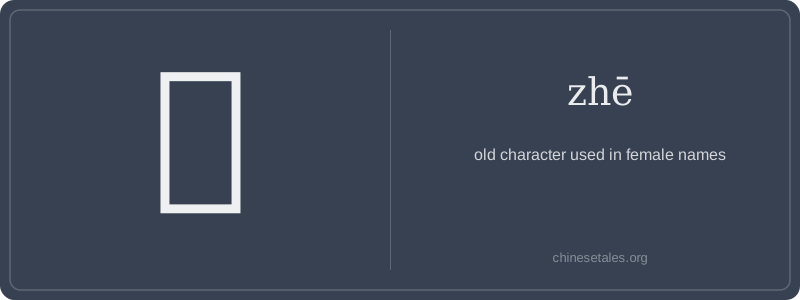
The character 嫬 does not appear in oracle bone or bronze inscriptions — it’s a later invention, first attested in Song-dynasty rhyme dictionaries and Ming-era name registers. Its structure is deliberately ornamental: the left radical 女 (nǚ, 'female') anchors its gendered domain, while the right side 者 (zhě) — originally a pictograph of an old man with staff and beard — was borrowed purely for sound (zhē) and aesthetic balance. Over centuries, scribes stylized 者 into a more flowing, decorative form, adding subtle flourishes to emphasize elegance over utility.
This visual fusion — woman + phonetic 'zhě' — wasn’t meant to depict action or object, but to evoke tonal harmony and cultural resonance. In classical texts like the *Complete Library of the Four Treasuries*, 嫬 appears only in biographical appendices, always in women’s posthumous names or literary pseudonyms. Its meaning never evolved semantically; instead, its *pragmatic function* narrowed: from occasional poetic variant to near-exclusive name marker by the late Qing. The character’s survival is less about linguistic necessity than about calligraphic tradition — like preserving a particular shade of ink because poets once loved it.
Imagine you're helping a friend transcribe her great-grandmother’s faded Qing-dynasty marriage contract — and there, nestled beside elegant calligraphy, appears the character 嫬. It doesn’t shout; it whispers. This isn’t a word you’d use in daily speech, nor one you’ll find on subway signs or WeChat menus. It’s a quiet relic: an archaic female-name character, pronounced zhē, used almost exclusively in pre-20th-century personal names to convey refinement, grace, or gentle virtue — like adding a silk ribbon to a name.
Grammatically, 嫬 functions only as a proper noun component — never as a verb, adjective, or standalone word. You’ll never say ‘she is 嫬’ or ‘this is very 嫬’. Instead, it appears fused into names like 柳嫬 (Liǔ Zhē) or 陳嫬娘 (Chén Zhēniáng), where it softens the phonetic root and signals feminine elegance. Learners sometimes mistakenly treat it like a modern adjective (e.g., trying to say *zhē de měilì*), but that’s linguistically impossible — it has no independent semantic weight outside naming contexts.
Culturally, 嫬 reflects how classical Chinese encoded gendered aesthetics through script: not via meaning per se, but via stylistic resonance and historical association. It’s not in any HSK list, nor in modern dictionaries beyond scholarly references — and if you try to type it on most keyboards, you’ll need Unicode input. Its rarity makes it a linguistic time capsule: beautiful, untranslatable, and utterly useless — unless you’re restoring ancestral records or writing historical fiction.