嫫
Character Story & Explanation
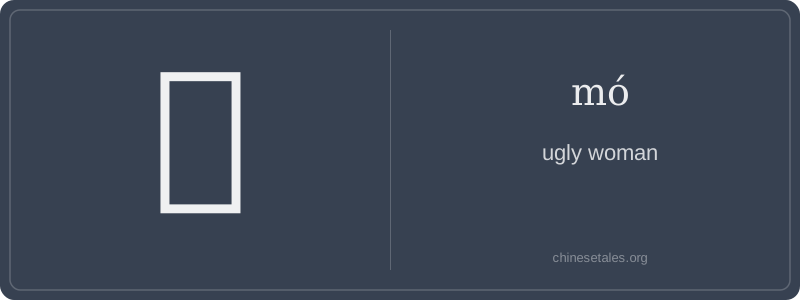
The earliest trace of 嫫 appears not in oracle bone script (where it’s absent), but in Warring States bamboo slips and Han dynasty seal script. Its structure is clearly semantic-phonetic: the left-side radical 女 (nǚ, ‘woman’) anchors meaning, while the right side, 模 (mó), originally pronounced *mô* in Old Chinese, provided both sound and conceptual weight — 模 meant ‘model’ or ‘pattern’, ironically underscoring the character’s paradox: this ‘ugly woman’ was held up as a *moral model*. Visually, early forms show three distinct strokes atop the right component — evolving from simplified pictographic lines representing disheveled hair or furrowed brows — later standardized into the modern 13-stroke form with the ‘林’-like top and ‘一’ base.
This duality crystallized in the *Huainanzi* (2nd c. BCE): ‘Mó Mǔ’s face was dark and rough, her nose upturned, her lips thick — yet she advised the Yellow Emperor on statecraft and virtue.’ Her name wasn’t a slur — it was a title earned through wisdom. Over time, 嫫 detached from its sole bearer and became a generic literary term for archetypal female ugliness — but always with undertones of undeserved marginalization. The character’s visual heaviness (13 strokes, dense right side) mirrors its semantic weight: not mere appearance, but a cultural litmus test for how society judges worth.
Think of 嫫 (mó) as China’s answer to the 'Ugly Duckling' — but with zero redemption arc. Unlike Western 'ugly' terms that soften with context (‘ugly sweater’ is cozy, ‘ugly truth’ is honest), 嫫 carries a sharp, classical sting — it’s not just unattractive; it’s mythically, almost comically grotesque, rooted in legend, not daily description. You’ll almost never hear it in modern speech — it’s literary, ironic, or deliberately archaic, like calling someone ‘a Lady Macbeth’ instead of ‘bossy’.
Grammatically, 嫫 functions only as a noun — never an adjective — and almost always appears in set phrases or allusions, like 嫫母 (Mó Mǔ), the legendary ‘ugliest woman under heaven’ who served as Empress Huangdi’s advisor. You won’t say *‘tā hěn mó’* (she’s very mó) — that’s ungrammatical and jarring. Instead, it appears in compound nouns (e.g., 嫫母) or metaphorical expressions (e.g., ‘rú mó rú yù’ — ‘like mo and jade’, contrasting extreme ugliness and beauty). Learners often mistakenly treat it like a regular descriptive word — a classic trap that signals over-literal translation thinking.
Culturally, 嫫 isn’t about aesthetics — it’s about moral inversion: in ancient texts, 嫫母 was so virtuous and wise that her ugliness became irrelevant, even admirable. So using 嫫 today can carry layered irony — praising inner worth while invoking outer flaw. Mistake it for a neutral synonym of ‘chǒu’ (ugly), and you risk sounding either wildly theatrical or unintentionally offensive. It’s not slang, not colloquial — it’s a linguistic antique, best deployed like a well-placed Shakespearean aside: rare, precise, and deeply intentional.