嫪
Character Story & Explanation
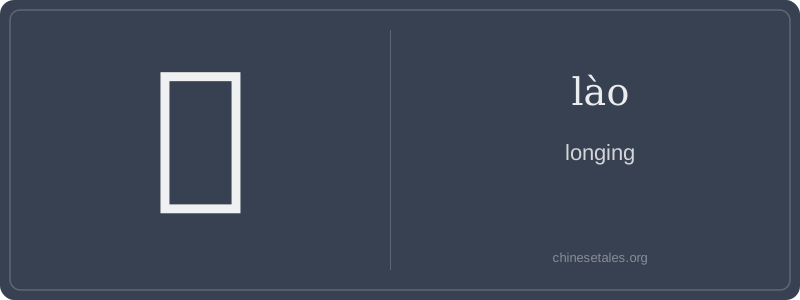
The earliest form of 嫪 appears on Warring States bamboo slips, not oracle bones — a subtle clue that it emerged later than many radicals suggest. Visually, it combines 女 (nǚ, 'woman') on the left — signaling emotional resonance traditionally associated with feminine interiority in classical texts — and 叟 (sǒu, 'old man') on the right. But here’s the twist: 叟 isn’t just 'old man'; in ancient script, it depicted an elder with bent back and hands clutching a staff, symbolizing endurance under weight — and in 嫪, that weight becomes emotional burden. The 14 strokes evolved carefully: the woman’s skirt (the three dots under 女) softened into flowing lines, while 叟’s head, arms, and staff fused into a compact, downward-pressing shape — like a heart bowed by yearning.
This character first bloomed in Han dynasty fu-rhapsodies and Tang dynasty yuefu songs, where poets used 嫪 to describe the ache of parted lovers or exiled officials mourning their capital. Li Bai didn’t write it, but Du Fu’s lesser-known 'Autumn Lament' uses 嫪 to describe the wind ‘longing for spring’ — personifying nature with human sorrow. Crucially, the character’s visual duality — woman + enduring elder — mirrors its semantic duality: tender feeling anchored in deep, patient suffering. No wonder it survives only in high-register literature: it’s too heavy for small talk.
At first glance, 嫪 (lào) feels like a quiet whisper in the Chinese lexicon — not loud like 爱 (love) or sharp like 恨 (hate), but deep, resonant, and emotionally viscous. Its core meaning is 'longing' — not the casual 'I miss you' kind, but the kind that settles in your bones: a yearning for someone absent, for a lost time, or for something unattainable. Think of a scholar gazing at autumn clouds while remembering his hometown — that’s 嫪. It’s rare in modern spoken Mandarin, appearing mostly in classical poetry, literary prose, or solemn, introspective writing. You’ll almost never hear it in daily chat; saying '我嫽你' would sound archaic or even poetic to native ears.
Grammatically, 嫪 functions as a verb (often transitive) or an adjective, but it *never* takes aspect particles like 了 or 过 — its power lies in its stillness. It pairs with classical subjects (e.g., 余, 吾, or names of historical figures) and often appears in parallel structures: '思之愈深,嫽之愈切' ('The deeper I think, the sharper the longing'). Learners sometimes mistakenly use it like 思念 (sīniàn), but 嫪 carries heavier emotional weight and zero colloquial flexibility — it’s not 'I miss my mom'; it’s 'My soul aches with longing for her departure.'
Culturally, 嫪 evokes the Confucian ideal of restrained yet profound emotion — grief held with dignity, love expressed through absence. A common learner trap is misreading it as 老 (lǎo, 'old') due to the shared 叟 component, or confusing it with 嫐 (nǎo, 'to annoy') — both visually similar but semantically galaxies apart. And yes: it’s absent from all HSK lists for good reason — it’s a jewel for readers of Tang poetry or Song ci, not for ordering dumplings.