嫣
Character Story & Explanation
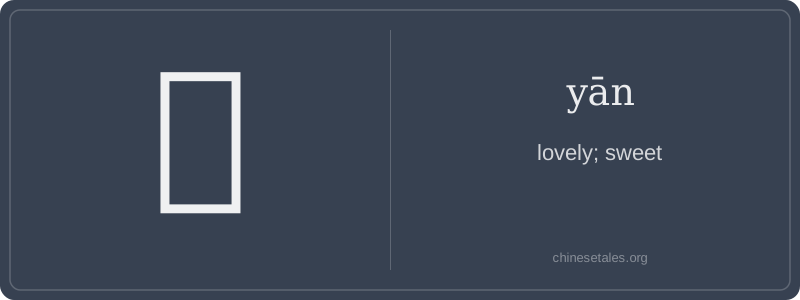
Oracle bone and bronze inscriptions show no direct precursor to 嫣 — it emerged later, during the Warring States period, as a phono-semantic compound. Its modern form crystallized in seal script: the left side is 女 (nǚ), unmistakably signaling feminine association; the right combines 言 (yán, 'speech') above and 攴 (pū, 'to tap' or 'to act') below — together forming the phonetic component yān. Though it looks like 言 + 攴, it’s not about speaking or hitting; rather, this right-hand cluster was borrowed purely for sound, while the meaning blossomed from the radical’s resonance with grace and charm.
By the Han dynasty, 嫣 appeared in texts like the *Shuōwén Jiězì*, defined as 'rich in color; charming in appearance'. It became a favorite in classical poetry — Li Bai used 嫣然 in lines evoking fleeting smiles, and Song dynasty poets paired it with 香 (xiāng, 'fragrance') to suggest beauty that lingers like scent. Visually, the 14 strokes flow like ink blooming on rice paper: the 女 radical curves gently, while the right side’s balanced layers (言’s three horizontal lines, then 攴’s decisive stroke) mirror the harmony of loveliness — neither overwhelming nor faint, but perfectly poised.
At its heart, 嫣 (yān) is a character that doesn’t just describe beauty — it evokes a soft, radiant, almost floral loveliness: think of blushing cheeks, dew-kissed peonies at dawn, or the gentle warmth in someone’s smile. It’s not flashy or bold like 美 (měi, 'beautiful') — it’s quieter, more poetic, and deeply feminine in connotation, anchored by its 女 (nǚ, 'woman') radical. You’ll rarely see it standing alone; it almost always appears in literary compounds like 嫣然 (yān rán, 'sweetly smiling') or 嫣红 (yān hóng, 'rosy red').
Grammatically, 嫣 functions almost exclusively as an adjective modifier — never as a verb or standalone noun — and it carries strong classical flavor. Using it in casual speech (e.g., saying '她很嫣' to mean 'She’s lovely') sounds jarringly archaic, like quoting Tang poetry at a coffee shop. Learners often overuse it trying to sound elegant, but native speakers reserve it for written descriptions, lyrical narration, or fixed idioms — never in daily conversation.
Culturally, 嫣 is a 'literary perfume' — subtle, refined, and tied to traditional aesthetics of restrained charm. Its visual composition (女 + 言 + 攴) hints at cultivated expression: a woman whose words and presence are gracefully persuasive. A common mistake? Confusing it with 焉 (yān, 'thereby') or 淹 (yān, 'to flood'), which share the sound but zero semantic overlap. Remember: if you’re describing delicate beauty — especially with color or expression — 嫣 might be your secret brushstroke.