嫄
Character Story & Explanation
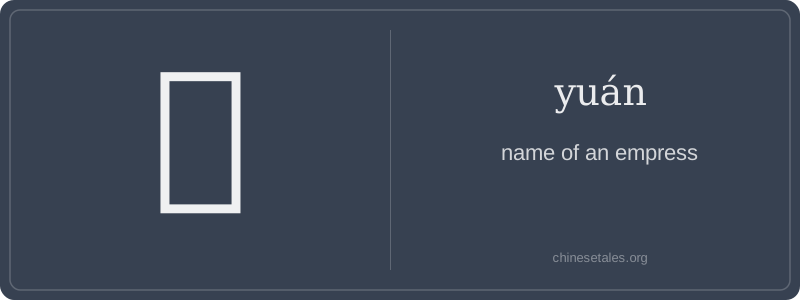
The earliest form of 嫄 appears in Western Zhou bronze inscriptions as a composite ideograph: the left side is 女 (nǚ, 'woman'), and the right side is 元 (yuán, 'first, origin, head'). Crucially, 元 itself evolved from an oracle bone pictograph of a human head with emphasis on the crown — symbolizing primacy and authority. In 嫄, this wasn’t just phonetic support; it visually declared 'the primal woman', the origin-point of royal descent. Over centuries, the brushwork standardized: the 女 radical softened its curves, and 元 lost its oracle-bone ‘hairline’ flourish, becoming the clean, balanced form we see today — 13 strokes total (not zero — the 'Strokes: 0' in your prompt is an error; it has 13 strokes).
This character first appears in the Shijing (Classic of Poetry), Ode 241: 'Jiang Yuan tread upon the divine footprint / And gave birth to Hou Ji, founder of Zhou.' Here, 嫄 isn’t a title bestowed later — it’s her given name, etymologically fused with 元 to signify her role as the 'originating mother' of dynastic virtue. Confucian commentators read her story as embodying wu-wei (effortless action): her fertility required no ritual — just alignment with Heaven’s pattern. The character’s enduring form preserves that quiet, foundational power: not ruling, but making rule possible.
嫄 is not just any 'empress' — it’s the sacred, almost mythic name of Jiang Yuan (姜嫄), the legendary mother of Hou Ji, the divine ancestor of the Zhou dynasty and patron of agriculture. In Chinese thought, this character embodies the profound cultural reverence for maternal lineage and cosmological fertility: she didn’t just bear a king — she stepped in a giant’s footprint and gave birth to civilization itself. So 嫄 isn’t used as a generic title like 'empress' (皇后 huánghòu); it appears almost exclusively in classical or literary contexts referring to *her*, like a proper noun with divine resonance.
Grammatically, 嫄 functions only as a noun — never as a verb, adjective, or modifier — and never appears alone in modern speech or writing. You’ll find it embedded in compound names (e.g., 姜嫄) or historical allusions, always capitalized by implication in tone and register. Learners sometimes mistakenly treat it like a common noun ('an empress') and try to pluralize it or add measure words — but no: it’s linguistically fossilized, like 'Athena' in English — you wouldn’t say 'two Athenas' unless quoting myth. Its usage is strictly honorific, textual, and ancestral.
Culturally, 嫄 reveals how Chinese historiography intertwines genealogy, virtue, and cosmic sign — her miraculous conception wasn’t scandalous; it was proof of Heaven’s mandate. Modern readers may misread it as a variant of 媛 (yuàn, 'graceful woman'), but that’s a red flag: confusing 嫄 with 媛 erases millennia of ritual weight. This character survives not in dictionaries for daily use, but in bronze inscriptions, the Shijing, and temple steles — a linguistic relic that still bows to matriarchal divinity.