媪
Character Story & Explanation
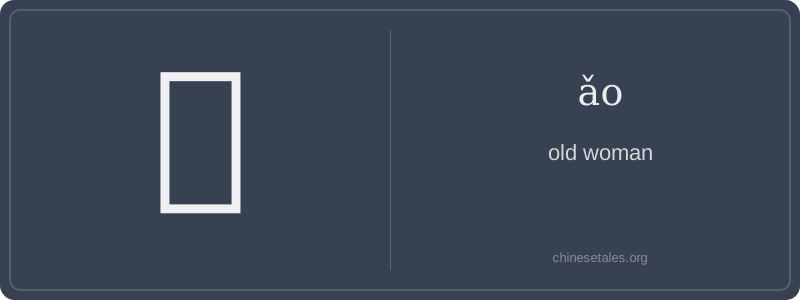
The earliest form of 媪 appears in seal script (around 3rd century BCE), where the left side clearly shows the 女 (nǚ) radical — a kneeling woman with emphasized hair and skirt — while the right side was originally ‘ǎo’ (a phonetic component derived from the character 懊, meaning ‘regret’, later simplified). Over centuries, the right side evolved: the upper part became 亠 (tóu, ‘lid’), then (a variant of 昂), and finally stabilized as 阿 (ā) — though here it serves purely as a sound hint, not a meaning carrier. The 12 strokes today neatly balance femininity (女, 3 strokes) and aged presence (阿, 9 strokes), mirroring its semantic duality.
In classical literature, 媪 appears with striking consistency — most famously in the Han dynasty text Shiji, where Sima Qian writes of ‘田舍老媪’ (a rustic old woman) offering shelter to a future emperor, symbolizing humble virtue recognized by fate. Later, in Tang poetry and Ming novels, 媪 gains emotional resonance: it’s the woman who mends clothes by lamplight, who remembers ancestral names, whose silence speaks volumes. Its visual structure — woman + phonetic ‘ā’ — subtly reinforces that her voice (even if soft) carries weight; the ‘ā’ echoes a gentle, open-mouthed utterance — not command, but counsel.
Ǎo isn’t just ‘old woman’ — it’s a term soaked in reverence and quiet dignity, often used in classical or literary contexts to evoke a grandmotherly figure who embodies warmth, wisdom, and unspoken authority. Unlike the neutral lǎo rén (老人) or the colloquial pópo (婆婆), 媪 carries a gentle, almost poetic weight — think of a storyteller by the hearth, not a passenger on the bus. It’s rarely used in casual speech today, which is why learners might overuse it (or worse, avoid it entirely), missing its subtle power in essays, historical dramas, or respectful address.
Grammatically, 媪 functions as a noun only — never as a verb or adjective — and typically appears with modifiers like lǎo (老媪), wú (吾媪, ‘my dear old mother’ in classical texts), or paired with 翁 (wēng) in the elegant duo 翁媪 (wēng ǎo), meaning ‘elderly couple’. You’ll almost never see it alone in modern headlines, but you *will* find it in phrases like ‘村中老媪’ (the village’s elderly woman) — where the modifier ‘lǎo’ isn’t redundant, but essential for natural usage.
Culturally, 媪 reflects how Chinese language honors age through specificity: it doesn’t mean ‘any old woman’, but one who has earned her place through time, care, and quiet endurance. A common learner mistake is confusing it with 婆 (pó) — but while 婆 can be affectionate, dismissive, or even pejorative (e.g., 太婆 vs. 傻婆), 媪 is consistently respectful and literary. Using it inappropriately (e.g., calling your friend’s grandma ‘ǎo’ without context) sounds oddly archaic — like addressing someone in Shakespearean English at a coffee shop.