媻
Character Story & Explanation
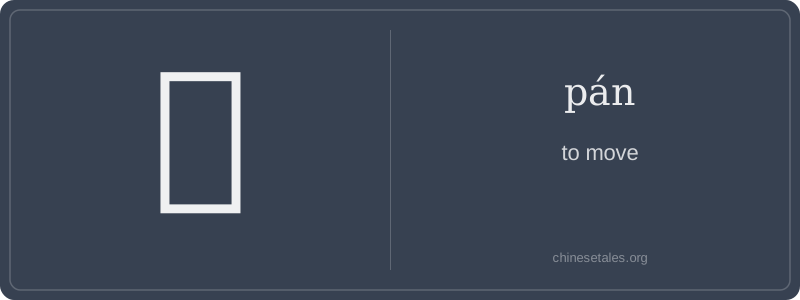
The earliest form of 媻 appears in bronze inscriptions as a composite pictograph: a person (人) beside a basin-like shape (possibly representing water or a ritual vessel), with a looping stroke suggesting circular motion or containment. Over time, the ‘person’ evolved into the radical 亻 (‘person’), while the right side solidified into 般 — originally a phonetic component meaning ‘boat’ or ‘to carry’, but here serving both sound and semantic reinforcement: boats pivot, turn, and adjust course on water. By the Han dynasty, the character stabilized as 媻, its two-part structure reflecting both agency (the person) and controlled motion (the turning action).
In classical texts like the Zuo Zhuan and early poetry, 媻 appears in phrases like 媻桓 (pán huán), describing a ruler pacing restlessly before making a fateful decision — not wandering aimlessly, but moving with deliberation, weighing options. Its visual symmetry (balanced left-right structure) mirrors its semantic core: centered, unhurried movement. Even today, calligraphers note how the downward stroke of 般 anchors the character — a visual metaphor for movement that begins from stillness, not speed.
Imagine watching a slow, deliberate dance in an ancient temple courtyard — not flashy or energetic, but deeply grounded, each step a quiet shift of weight, a subtle repositioning of the body. That’s 媻 (pán): it doesn’t mean ‘run’, ‘walk’, or ‘go’ — it means *to move* in the sense of shifting, adjusting, or reorienting oneself *in place*, often with intention, care, or even reluctance. It’s movement without displacement: turning, pivoting, settling, or easing into a new posture or stance.
Grammatically, 媻 is almost exclusively literary and classical — you’ll rarely hear it in spoken Mandarin today. It appears mainly as a verb in formal or poetic contexts, often followed by directional complements (e.g., 媻身 ‘turn one’s body’) or in compound verbs like 媻桓 (pán huán, ‘to linger, pace back and forth’). Learners sometimes misread it as a synonym for 走 or 行, but using 媻 in casual speech (“I’m going to the store”) would sound bizarrely archaic — like saying ‘henceforth I shall wend my way’ at the grocery checkout.
Culturally, 媻 carries a quiet gravitas: it evokes classical restraint, Daoist fluidity, or Confucian composure. Its rarity makes it a telltale sign of sophisticated literary fluency — and a common trap in classical Chinese exams, where students confuse it with phonetically similar characters. Crucially, it’s *not* used for locomotion over distance — that’s what 步, 行, or 走 are for. Think of 媻 as the character for the moment *between* steps: the breath before the turn, the subtle recalibration of presence.