媬
Character Story & Explanation
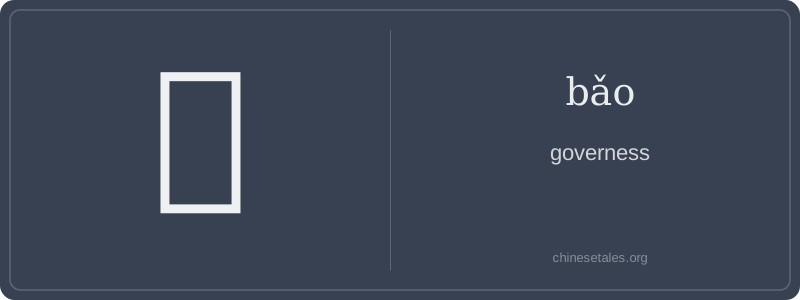
The earliest attested form of 媬 appears in Han dynasty clerical script, not oracle bone: it’s a phono-semantic compound built from 女 (nǚ, ‘woman’) on the left and 保 (bǎo, ‘to protect, safeguard’) on the right. Visually, the left radical 女 is unmistakable—a stylized kneeling woman with bent arms—while 保 retains its ancient structure: a person (亻) sheltering a child (子) under a roof (宀). Over centuries, the right side simplified from the fuller seal-script 保 to its modern form, but the semantic logic remained intact: ‘a woman who safeguards [a child’s upbringing].’ No bronze inscriptions bear this exact character—it emerged later, as elite households formalized domestic pedagogy.
This character crystallized during the Ming–Qing period, appearing in texts like Biographies of Exemplary Women (列女傳) and household manuals advising gentry families on hiring ‘virtuous, literate women’ (貞淑有文之婦) as 媬. Its meaning never drifted toward general caregiving—it stayed tightly bound to moral instruction and literary training for girls. Interestingly, the same 保 component appears in 保姆, but there it emphasizes physical care; in 媬, 保 is elevated to ethical stewardship. The visual fusion—female + safeguard—thus encodes a cultural ideal: nurturing intellect and virtue, not just the body.
Imagine a quiet, sunlit courtyard in late Qing Dynasty Beijing: a young girl in embroidered silk sits cross-legged on a woven mat, carefully copying calligraphy strokes while an elderly woman—her 媬—watches with gentle but unwavering eyes, correcting her wrist angle with a single fingertip. This isn’t just ‘nanny’ or ‘teacher’; 媬 carries the quiet authority of a female mentor entrusted with moral cultivation, literacy, and etiquette—not just childcare. It’s a role steeped in Confucian ideals of feminine pedagogy, reserved for educated women hired by elite families to shape daughters’ character before marriage.
Grammatically, 媬 is almost always used as a noun, rarely pluralized (no 们), and typically appears with possessive markers like 我的 or 小姐的—e.g., ‘小姐的保母’ sounds archaic and off; it’s always 小姐的媬. Crucially, it’s *not* used in modern spoken Mandarin—it’s literary, historical, or stylistically marked. You’ll find it in novels set in imperial China or in formal biographies, never in a daycare brochure. Learners often mistakenly substitute it for 保姆 (bǎomǔ) or 老师 (lǎoshī), but doing so strips away its gendered, aristocratic, and pedagogical specificity.
Culturally, 媬 evokes a vanished world where female education was private, intimate, and deeply hierarchical. Unlike today’s certified early-childhood educators, a 媬 was expected to embody virtue herself—and her influence was believed to seep into a girl’s very comportment. Modern learners sometimes overuse it trying to sound ‘authentic’, but native speakers instantly flag it as either deliberate historical pastiche or a charmingly anachronistic slip—like calling your yoga instructor ‘a Confucian sifu’.