娲
Character Story & Explanation
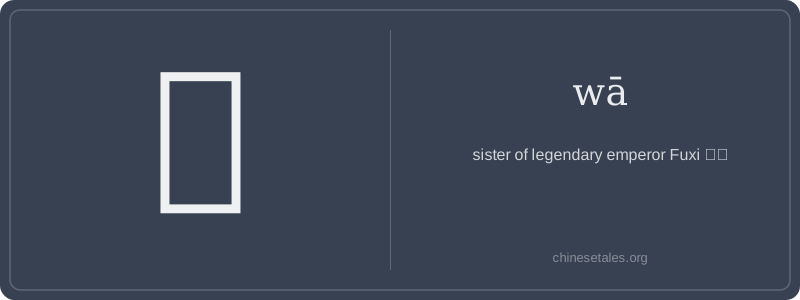
The earliest trace of 娲 appears not in oracle bones—but in Warring States bamboo slips, where it’s written as 女+咼 (a phonetic component meaning ‘hollow’ or ‘concave,’ hinting at resonance or echo). Visually, the left 女 radical grounds it in femininity and creation; the right 咼 (guā) was chosen for sound, not sense—its 9 strokes evolving into today’s simplified 10-stroke form with a subtle curve in the final stroke mimicking the arc of a clay coil. There’s no pictograph of a goddess weaving stars—just elegant phonetic borrowing wrapped in ritual gravity.
By the Han dynasty, 娲 solidified as part of 女娲 in texts like the *Huainanzi*, where she mends the sky with five-colored stones and fashions humans from yellow clay. Crucially, her name wasn’t written with variant characters—it resisted simplification, semantic drift, or colloquial erosion. Unlike many mythic names that faded or morphed, 娲 remained orthographically frozen, a linguistic artifact preserved precisely because it belonged to cosmogony, not commerce. Its visual stability mirrors its cultural role: unchanging, foundational, and utterly irreplaceable.
Imagine standing before a crumbling Tang-dynasty temple mural: there she is—Nüwa 女娲—serene yet powerful, one hand holding a compass, the other cradling a lump of yellow clay. Her name isn’t just a label; it’s a cultural keystone. 娲 (wā) appears almost exclusively in her full name 女娲—never alone in modern usage—and carries zero independent lexical weight. You’ll never say ‘I saw a wā’ or ‘this wā is beautiful.’ It exists only as the second syllable of a mythic proper noun, like ‘-ith’ in ‘Amphitrite’—a phonetic anchor with no standalone meaning.
Grammatically, 娲 functions solely within the compound 女娲, always as a proper noun subject or topic. It never takes modifiers, doesn’t pluralize, and never appears after measure words. Learners sometimes mistakenly treat it like a regular noun and try to say *女娲们 (nǚ wā men)* or *一个女娲 (yī gè nǚ wā)*—but that’s as unnatural as saying ‘a Zeus’ in English. The character is fossilized: its job is to complete the sacred duo with Fuxi, not to flex grammatical muscles.
Culturally, mispronouncing 娲 as wō or wǎ (instead of wā) instantly marks you as unfamiliar with classical mythology—like calling ‘Odysseus’ ‘O-dee-suss.’ And while 女 is a productive radical (appearing in 妈, 姐, 婚), 娲 has zero derivational relatives. No verbs, no adjectives, no slang. Its entire existence is mythic, ceremonial, and unyielding—preserved not in daily speech, but in stone inscriptions, opera libretti, and the opening lines of dynastic histories.