媢
Character Story & Explanation
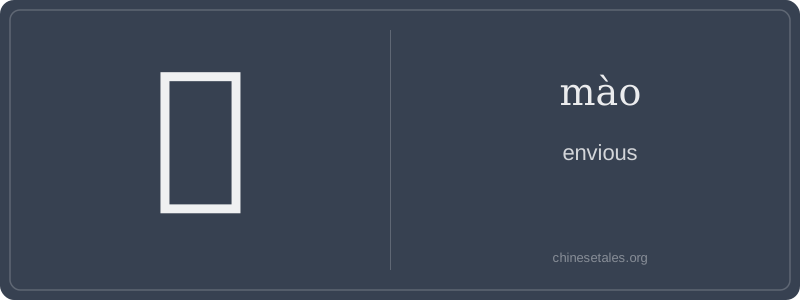
媢 first appeared in bronze inscriptions around 800 BCE—not as a standalone character, but embedded in compound forms like 嫉媢. Its earliest form shows 女 (nǚ, 'woman') on the left, anchoring the meaning in gendered social dynamics, and 冒 (mào, 'to emerge, to dare') on the right, which originally depicted a person’s head emerging from under a covering (like steam rising or a person stepping boldly forward). Over centuries, the top of 冒 simplified from ⛩ (a stylized hat/head + eyes) to 冂 + 目, then further to the modern 冂 + 日 shape—yet the sense of 'bold emergence' remained, twisting here into 'envy that dares to surface, unbidden.'
By the Han dynasty, 媢 was codified in texts like the *Shuōwén Jiězì* (121 CE) as 'jealousy born of women's rivalry,' reflecting societal anxieties about female influence at court. In Tang poetry, it appears in lines describing palace ladies’ hidden resentment; by the Ming novel *Jin Ping Mei*, it’s used to dissect the psychological warfare among wives and concubines. Crucially, its visual structure—female + bold emergence—mirrors its semantic tension: envy isn’t passive; it’s an aggressive, socially dangerous force that ‘steps forward’ where it shouldn’t.
媢 (mào) is a beautifully sharp, almost archaic word for 'envious'—but not just any envy. It’s the kind that simmers with resentment, often gendered in classical texts: the bitter, watchful jealousy of one woman toward another’s beauty, status, or favor. Think less 'I wish I had that bag' and more 'I can’t bear to see her praised while I’m overlooked.' It’s emotionally charged, literary, and rarely used in casual speech today—more likely to appear in historical novels, poetry, or scholarly analysis of Ming/Qing court intrigue.
Grammatically, 媢 is almost always an adjective modifying nouns (e.g., 媢心 'envious heart') or appearing in fixed compounds like 嫉媢. It doesn’t stand alone as a predicate verb ('She is 媢')—you’d never say *她媢*; instead, it appears in tightly bound phrases or as part of a descriptive noun phrase. Learners sometimes mistakenly treat it like 嫉 (jí, 'jealous') and try to use it predicatively or with aspect particles (e.g., *媢了*), but it resists such modern grammatical stretching—it’s a fossilized literary adjective, not a living verb.
Culturally, 媢 carries baggage: historically linked to female rivalry in patriarchal settings (e.g., concubines competing for imperial favor), its usage subtly reinforces how Confucian social structures encoded emotional hierarchies into language. Modern writers may deploy it ironically or critically—to expose toxic comparison—or avoid it entirely due to its dated, gendered connotations. A common mistake? Confusing it with 募 (mù, 'to recruit') or 慕 (mù, 'to admire')—same sound, opposite moral valence!