媊
Character Story & Explanation
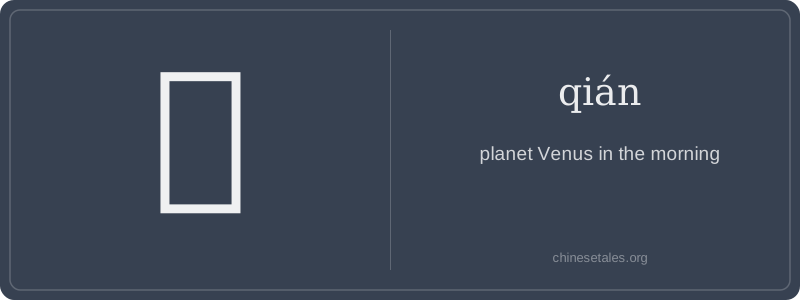
The character 媊 first appeared in late Warring States bamboo manuscripts, not oracle bones — and its form is a deliberate fusion, not a pictograph. The left side 女 (nǚ, 'woman') was borrowed for its phonetic value (in ancient dialects, 女 had readings close to *gən* or *ŋan*, evolving toward qián), while the right side 軒 (xuān, 'elegant carriage with high canopy') was simplified over centuries from a complex bronze script glyph depicting a chariot under an open roof — symbolizing elevation, visibility, and celestial vantage. By the Han dynasty, the right component had condensed into 干 (gān), losing its original 'chariot' meaning but retaining phonetic resonance and the idea of 'uprightness' or 'prominence'.
This visual marriage — 'woman' + 'elevated presence' — wasn’t about gender, but about harmony: in early Chinese cosmology, Venus (as 媊) was associated with Yin energy manifesting visibly at dawn — gentle yet commanding, like a noble woman stepping onto a raised terrace to greet the light. The Shuōwén Jiězì (100 CE) classifies it under 女, noting 'it shines brightly in the east, pure and serene — thus bearing the 女 radical, signifying refinement, not femininity'. Later poets like Li Bai invoked 媊星 to evoke solitude and transcendence — 'I drink alone beneath the 媊' — linking its cold, distant radiance to quiet introspection.
First, let’s clear up a big misconception: 媊 (qián) isn’t used in modern spoken Mandarin at all — it’s a classical astronomical term, exclusively for Venus when it appears in the eastern sky before sunrise. Its core meaning is poetic and precise: not just 'Venus', but specifically the 'Morning Star' — a celestial herald of dawn, carrying connotations of clarity, auspicious beginnings, and celestial order. You’ll never hear it in daily conversation or see it on subway signs; it lives in poetry, historical star charts, and Daoist cosmological texts.
Grammatically, 媊 functions only as a noun — always with modifiers or in fixed phrases like 媊星 (qián xīng). It doesn’t take aspect particles (了, 过), doesn’t pluralize, and never appears alone in a sentence. Learners sometimes mistakenly insert it into sentences like *'今天我看到媊' — but that’s ungrammatical without context or modifier (e.g., 媊星). It also never pairs with modern measure words like 颗; instead, classical texts use units like 座 (for constellations) or omit counters entirely.
Culturally, 媊 reflects ancient China’s sophisticated naked-eye astronomy — Venus was tracked meticulously because its cycles aligned with agricultural and ritual calendars. A common error is confusing it with 金星 (jīn xīng), the modern term for Venus: while 金星 refers to the planet anytime, 媊 *only* applies at dawn — and even then, only in literary or archaic registers. Using 媊 in a weather app or news report would sound like quoting a Tang dynasty poem at a coffee shop.