媅
Character Story & Explanation
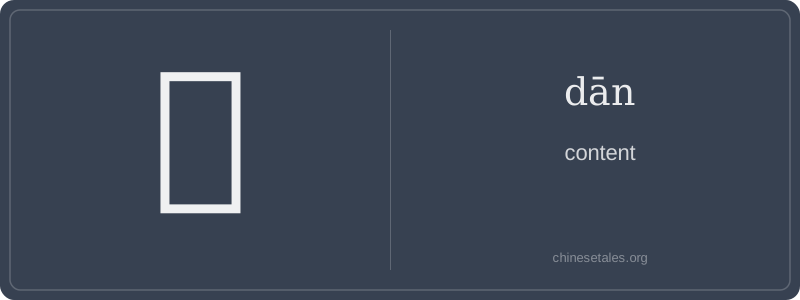
The earliest form of 媅 appears in Warring States bamboo slips (c. 475–221 BCE), not oracle bones — and its structure is a revelation: left side 女 (nǚ, woman), right side 丹 (dān, cinnabar/red pellet). This wasn’t arbitrary: in early cosmology, cinnabar symbolized the perfected elixir of immortality — the ultimate inner alchemy. The ‘woman’ radical anchored the character in embodied, generative stillness (not passivity!), suggesting contentment as fertile calm, not inertness. Over centuries, the 丹 component simplified from a box with a dot (◎) representing the elixir pellet to today’s streamlined form — yet the red-elixir symbolism remained embedded in the shape.
By the Han dynasty, 媅 appeared in texts like the Huáinánzǐ, describing the sage who ‘dwells in 媅’ — a state where mind and breath align without effort, like water settling in a bowl. Its meaning never shifted toward ‘satisfaction with something’; rather, it deepened into metaphysical sufficiency — the absence of craving itself. Crucially, it was never used in administrative or ritual texts, only philosophical poetry. That explains its near-total disappearance from spoken language: when Confucian pragmatism rose, characters naming active virtue (like 仁 rén, benevolence) eclipsed ones naming passive wholeness. Yet its visual DNA — woman + elixir — still whispers: true contentment is not found, but forged within.
Here’s the truth no textbook tells you: 媅 (dān) isn’t just ‘content’ — it’s the quiet, almost sacred stillness that follows deep satisfaction, like exhaling after holding your breath for a lifetime. In classical Chinese, it describes a state of inner fullness so complete that desire dissolves; it’s not happiness or joy, but the profound calm *after* want has vanished. Modern usage is vanishingly rare — you’ll almost never hear it in speech or see it in newspapers. It survives only in literary or poetic contexts, often paired with words like 心 (xīn, heart) or 意 (yì, intention), where it adds a layer of serene finality.
Grammatically, 媅 functions exclusively as an adjective or stative verb — never as a noun or verb meaning ‘to content’. You won’t say ‘I content myself’ — instead, you might write 心媅 (xīn dān), ‘the heart is content’, with no particle or auxiliary needed. Learners mistakenly try to use it like 满足 (mǎnzú) or 满意 (mǎnyì), but 媅 carries zero transactional energy — there’s no object being satisfied, no standard being met. It’s self-contained, uncaused, and deeply introspective.
Culturally, 媅 reflects an ancient Daoist-Buddhist ideal: contentment not as resignation, but as luminous equilibrium — the mind undisturbed by lack *or* excess. A common mistake? Assuming it’s interchangeable with 安 (ān, peace) or 静 (jìng, stillness). But while those describe external conditions, 媅 names an internal state so absolute it borders on emptiness. Its rarity today makes it feel like finding a fossil — beautiful, precise, and utterly out of time.