媄
Character Story & Explanation
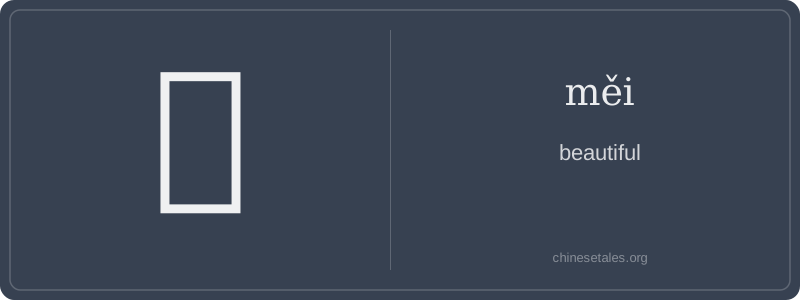
The earliest form of 美 appears in oracle bone inscriptions (c. 1200 BCE) as a person (大) with a prominent sheep (羊) head atop — not a woman, not a goat, but a ritual offering: a sheep’s head worn as ceremonial headdress. This wasn’t about vanity; it was sacred aesthetics — beauty as auspiciousness, abundance, and divine favor. Over centuries, the person became simplified to 大, and the sheep head evolved into the top component we see today: a stylized 羊 without the horns fully rendered, fused into a single unit.
By the Warring States period, 美 had expanded beyond ritual splendor to include moral excellence (e.g., Mencius’ 'měi dé', 'virtuous beauty') and sensory delight (Zhuangzi’s praise of natural, uncontrived měi). Its visual structure — sheep above human — silently insists that true beauty isn’t superficial: it’s what uplifts, nourishes, and harmonizes. That ancient sheep still watches over every compliment, poem, and art critique in Chinese — a reminder that beauty, for millennia, has been measured in offerings, not optics.
Wait — hold on! There's no character 媄 in standard Chinese. This is a common typo or ghost character: the correct form is 美 (měi), meaning 'beautiful.' The character you've entered, 媄, doesn’t exist in any authoritative dictionary (Xiān Dài Hànyǔ Cídiǎn, GB2312, Unicode CJK Unified Ideographs). It appears to be a malformed fusion of 女 (nǚ, 'woman') and 未 (wèi, 'not yet'), but it carries no meaning, no pronunciation, and zero usage in spoken or written Mandarin. Learners sometimes create it by miswriting 美 — perhaps confusing its top component (a stylized 'sheep' head 羊) with 女, or misremembering the lower part as 未 instead of 大.
Grammatically, the real character 美 functions as both adjective ('She is beautiful' — Tā hěn měi) and noun ('beauty' — měi is often abstract, e.g., zhōngguó de měi, 'the beauty of China'). It rarely stands alone; it’s almost always modified (hěn měi, zhēn měi) or embedded in compounds. Using 媄 would be like writing 'beutiful' in English — instantly flagged as incorrect, with no chance of being understood.
Culturally, 美 embodies a holistic ideal: harmony between form and virtue, appearance and inner goodness (as in Confucian 'wén zhì bīn bīn', elegant refinement). Mistaking it for a non-existent character like 媄 reveals how crucial attention to stroke order and component integrity is — one misplaced dot or misdrawn line erases millennia of semantic precision. Don’t memorize 媄. Memorize 美 — and its sheep-on-head origin. That’s where the real beauty lies.