媁
Character Story & Explanation
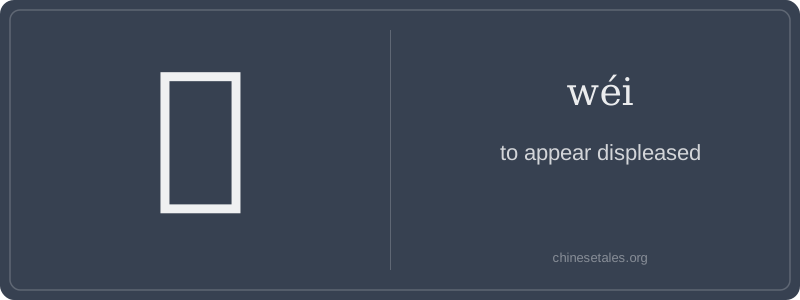
媁 has no oracle bone or bronze script form — it’s a late creation, first attested in the Shuōwén Jiězì (c. 100 CE), where Xu Shen classified it under the 女 (nǚ, ‘woman’) radical. Visually, it’s a compound: left side 女 (a kneeling woman with arms folded — symbolizing propriety), right side 韋 (wéi, ‘tanned leather’), which here serves *phonetically*, not semantically. The ‘leather’ component was chosen for its sound (wéi), not its meaning — though leather’s stiffness subtly echoes the rigidity of disapproval. Over centuries, the ‘woman’ became more stylized, the ‘leather’ simplified from 12 strokes to its modern 9-stroke form — yet the quiet tension between femininity and firmness remained.
This character didn’t emerge from daily life but from textual refinement: early literati needed a precise term for the kind of dignified displeasure appropriate to ritual, poetry critique, or courtly conduct. In the Wen Xuan (6th c.), it appears in phrases like ‘媁而不言’ (wéi ér bù yán — ‘displeased yet silent’), capturing the Confucian ideal of restraint. Its visual duality — woman + leather — mirrors its semantic duality: soft social role meets unyielding moral standard. No wonder it vanished from speech: such nuance doesn’t survive the speed of modern talk.
Let’s be honest: 媁 (wéi) is a rare, elegant ghost of classical Chinese — not something you’ll hear in a Beijing teahouse or see on WeChat. Its core feeling is subtle disapproval: not anger, not shouting, but that quiet, tightening-of-the-lips expression when someone says something tactless, ill-timed, or just plain unbecoming. Think of a Ming-dynasty scholar raising one eyebrow at a poorly composed poem — it’s facial, restrained, and deeply contextual.
Grammatically, 媁 is almost always used as a verb in literary or formal writing, often with a subject + 媁 + object structure: ‘She 媁 his remark’ (她媁其言). You’ll rarely find it in modern spoken Mandarin — trying to use it in casual conversation would sound like quoting Confucius at a coffee shop. It pairs naturally with classical particles like 其 (qí, ‘his/her/its’) or 之 (zhī), and never takes aspect markers like 了 or 过. So no ‘she wéi-ed’ — it stands bare, like a single brushstroke in ink painting.
Culturally, this character reflects the Confucian premium on emotional restraint and face-saving: displeasure isn’t denied — it’s signaled with precision and economy. Learners’ biggest mistake? Confusing it with 威 (wēi, ‘power/intimidation’) or 易 (yì, ‘easy’) due to visual similarity — but 媁 isn’t about force or simplicity; it’s about the micro-expression of moral or aesthetic judgment. Also: don’t stress over the alternate pronunciation wěi — it appears only in ancient phonetic glosses and poetic rhyme dictionaries, not real usage.