婽
Character Story & Explanation
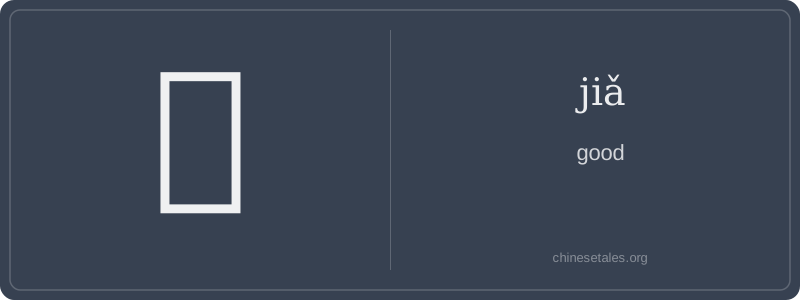
The earliest form of 婽 appears in late Western Zhou bronze inscriptions as a single horizontal stroke — yes, just one line — placed above a simplified representation of a sacrificial vessel or altar. That lone stroke wasn’t decorative; it symbolized the 'highest offering', the topmost tier of ritual purity and excellence. Over centuries, the altar glyph evolved into the radical 亠 (tóu, 'lid' or 'cover'), while the horizontal stroke remained — now flanked by two vertical strokes (丨丨) representing upright pillars of virtue. By the Han dynasty clerical script, these had standardized into the modern form: 亠 + 丨 + 丨 — three strokes total, visually echoing 'the highest point supported by two pillars of integrity'.
This minimalist design reflects early Chinese cosmology: excellence isn’t flashy or complex — it’s structural, balanced, and elevated. Confucius used 婽 in the Analects (though later editions often substituted shàn) to describe the ideal ruler’s conduct — not 'good behavior', but 'conduct so perfectly aligned with Heaven’s will that it requires no embellishment'. In the Tang dynasty, poets like Li Bai revived 婽 in parallel couplets to evoke sublime natural grandeur ('mountains towering — 婽! rivers flowing — shèn!'). Even today, calligraphers revere its stark geometry: three strokes, zero flourishes — excellence stripped bare.
Here’s the truth no textbook tells you: 婽 (jiǎ) doesn’t mean 'good' in the cheerful, modern sense — it’s an archaic, almost ceremonial word for 'excellent', 'superb', or 'peerless', used only in classical set phrases, poetic diction, or formal literary registers. Think of it as the Mandarin equivalent of Shakespearean 'excellent' — elegant, weighty, and utterly out of place in a coffee shop conversation. Its feel is reverent, even awe-struck: not just 'good', but 'so good it borders on the divine'. You’ll never hear it in daily speech — not in 'This food is good' (that’s hǎo), not in 'She’s a good student' (that’s hǎo again). It belongs on bronze inscriptions, not WeChat messages.
Grammatically, 婽 functions exclusively as an adjective — and only in fixed compounds or parallel classical structures. It never stands alone like hǎo does. You won’t say *'this book is 婽' — instead, you’ll find it in rigid four-character idioms like 才高八斗 (cái gāo bā dǒu, 'talent towering eight dou') where 婽 might appear in poetic variants, or in classical apposition: '其德甚 婽' ('his virtue is exceedingly excellent'). It’s also occasionally used as a verb in ancient texts meaning 'to esteem highly' — a usage so rare today that most native speakers wouldn’t recognize it without context.
Culturally, 婽 reveals how Chinese values precision in moral and aesthetic judgment: 'good' isn’t one shade — it’s a spectrum from hǎo (baseline acceptable) to shàn (virtuous, ethical) to jiǎ (transcendent, exemplary). Learners’ biggest mistake? Assuming it’s a synonym for hǎo and dropping it into casual sentences — which sounds either hilariously pompous or deeply confusing. Worse, some confuse it with jiā (family) or jiǎ (fake) — both homophones with vastly different meanings. Remember: 婽 is a museum piece, not a working tool.