婼
Character Story & Explanation
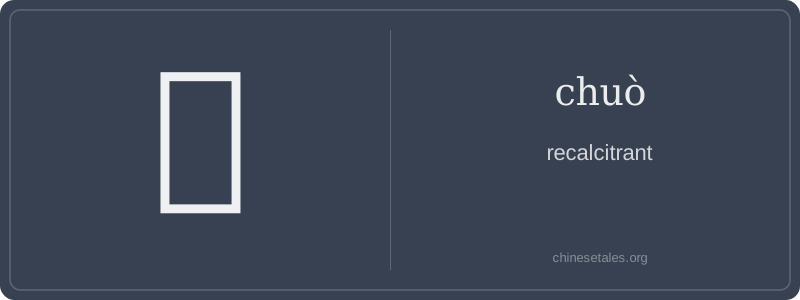
The earliest attested form of 婼 appears in late Warring States bamboo manuscripts — not oracle bones, but ink-written slips where its structure is already clear: the left-side 女 (nǚ, 'woman') radical, and right-side 叕 (zhuó), a rare phonetic component meaning 'to pile up repeatedly'. Crucially, 叕 itself is composed of three stacked 'again' (又) glyphs — visualizing relentless, cyclical action. So 婼’s original script wasn’t pictographic but ideophonetic: a woman (social role) paired with 'repeated again-and-again', implying persistent, iterative defiance — not a one-off tantrum, but ingrained, habitual resistance.
This layered etymology shaped its classical usage: in the *Book of Rites* (Lǐjì), 婼 appears in passages condemning 'children who 婼 their parents’ commands', where the repetition in 叕 underscores the *pattern* of disobedience. Over time, as vernacular language rose, simpler terms like 顽 (wán, 'willful') or 逆 (nì, 'rebellious') replaced it. Yet its visual logic endured: the three 'again's in 叕 became shorthand for moral obstinacy so deep it loops back on itself — a nuance no modern synonym quite captures. Today, its form is a silent echo of how ancient scribes encoded ethics into stroke order.
At first glance, 婼 (chuò) feels like a linguistic ghost — it’s real, it’s in the dictionary, but you’ll almost never hear it spoken or see it written outside classical texts or scholarly footnotes. Its core meaning, 'recalcitrant' or 'obstinately disobedient', carries a distinctly moral weight: this isn’t just stubbornness — it’s willful resistance to rightful authority, especially filial or social hierarchy. In classical usage, it often described children defying elders or ministers opposing a virtuous ruler — always with an implied ethical judgment.
Grammatically, 婼 is nearly extinct as a standalone word in modern Mandarin. You won’t find it in verbs, adjectives, or everyday speech. It appears almost exclusively in literary compounds (like 婼逆 or 婼悖), where it functions as a formal, archaic morpheme intensifying moral rebellion — think of it like English ‘refractory’ in medical or legal jargon: precise, heavy, and deliberately out-of-fashion. Learners sometimes try to use it like a modern adjective (e.g., *tā hěn 婼*), but that’s grammatically alien — it doesn’t take degree adverbs or predicate structure.
Culturally, 婼 reveals how deeply Chinese ethics embedded behavioral expectations into language itself: disobedience wasn’t neutral — it needed a character with its own radical (女) and phonetic component (叕), signaling both gendered social roles and layered historical condemnation. A common mistake is misreading it as 女 + 又 or confusing it with 惙 (chuò, 'dejected') — but 婼 isn’t about emotion; it’s about deliberate, principled (or perverse) defiance. Its near-total absence from HSK and daily life makes it a fascinating relic — not a tool for communication, but a fossil of Confucian moral grammar.