婹
Character Story & Explanation
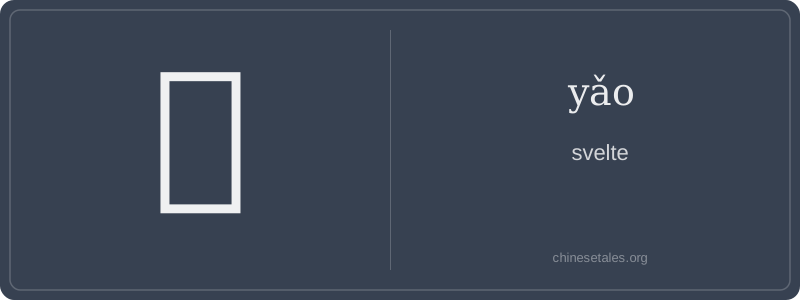
The earliest attested form of 婹 appears in Han dynasty clerical script, not oracle bones — it’s relatively late in the character’s evolution. Its left side is the ‘female’ radical (女), anchoring it to human (especially feminine) grace. The right side, 杳 (yǎo), originally depicted a person under trees — later abstracted to mean ‘deep, remote, dim’ — suggesting something elusive, subtly present yet hard to grasp. Over centuries, the strokes simplified: the ‘tree’ component became 日 (sun/day) plus 木 (wood), then further stylized into 杳’s current shape — a visual metaphor for depth and quiet presence.
This duality — female + deep/remote — crystallized in the *Shijing* (*Book of Songs*), where 婹 appears in the iconic phrase 婹窕淑女 (yǎo tiǎo shū nǚ): ‘a graceful, virtuous lady’. Here, 婹 doesn’t just describe body shape — it evokes moral refinement, inner stillness, and cultivated poise. The character’s very structure insists that svelteness is inseparable from depth of character. Even today, when writers use 婹, they’re invoking that ancient linkage: outer elegance as the visible echo of inner substance.
At first glance, 婹 (yǎo) feels like a whisper — not a shout. It doesn’t mean ‘thin’ or ‘slim’ in the clinical, numerical sense (like 瘦 shòu), but rather evokes a graceful, poised slenderness: lithe, supple, almost dancer-like — think of willow branches bending in wind, not a ruler’s measurement. In classical Chinese, it was almost exclusively poetic, used to describe women’s refined bearing or natural forms (a mountain ridge, a stream’s curve), carrying connotations of elegance *and* quiet strength.
Grammatically, 婹 is rare as a standalone adjective in modern speech — you won’t hear ‘她很婤’ on the subway. Instead, it appears embedded in literary compounds (like 婹窕 yǎo tiǎo) or as a descriptive modifier in formal writing, poetry, or historical fiction. Learners often mistakenly treat it like a casual synonym for ‘slim’, but using it alone sounds archaic or jarringly ornate — like quoting Shakespeare at a coffee shop. It’s an adjective that demands context: it needs rhythm, imagery, or parallel structure to land.
Culturally, 婹 reveals how Chinese aesthetics value *harmony between form and vitality*: svelteness here isn’t about absence (of fat, of mass), but about dynamic balance — tension and flow coexisting. A common error is overgeneralizing its usage; it’s never used for inanimate objects without poetic license (e.g., you wouldn’t call a pencil ‘婹’ — but you *might*, in a poem, call a moonlit bamboo stalk ‘婹’). Its survival is a testament to the enduring power of lyrical precision in Chinese.