婷
Character Story & Explanation
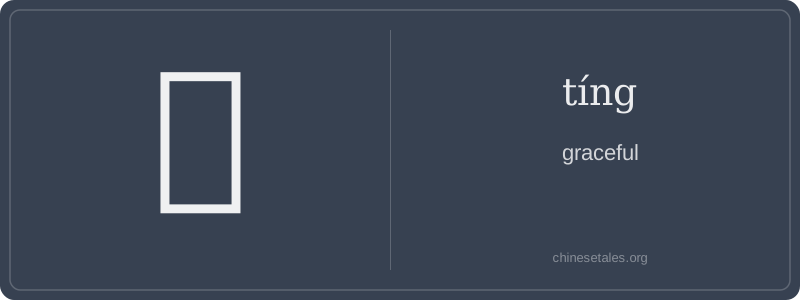
The earliest form of 婷 appears in seal script (c. 3rd century BCE), where it already combines 女 (nǚ, ‘woman’) on the left with 亭 (tíng, ‘pavilion’) on the right — no pictographic origin in oracle bones, because it’s a later phono-semantic compound. The left side 女 clearly marks gender association; the right side 亭 provides both sound (tíng) and subtle semantic resonance: pavilions in classical China were elegant, symmetrical structures — open yet grounded, airy yet dignified — mirroring the idealized feminine poise the character came to signify.
By the Han dynasty, 婷 appears in texts like the Shuōwén Jiězì (c. 100 CE) as ‘a woman’s graceful bearing’, with 亭 reinforcing stability and aesthetic harmony. Over centuries, its usage narrowed from general description to almost exclusively personal names — likely because its delicate phonetic and semantic balance made it perfect for naming daughters. Poets like Li Qingzhao (Song dynasty) didn’t use 婷 alone, but its compound form 婷婷 became standard in imagery like ‘婷婷袅袅’ (tíngtíng niǎoniǎo) — capturing the swaying, unhurried elegance of youth and refinement.
婷 (tíng) is all about poised elegance — not just physical grace, but the quiet, effortless composure of someone who moves with inner harmony. It’s almost exclusively used in female given names (e.g., 王婷 Wáng Tíng), where it adds a refined, poetic resonance — like ‘graceful as a willow branch bending in spring wind’. Unlike descriptive adjectives such as 漂亮 (piàoliang, ‘pretty’) or 优雅 (yōuyǎ, ‘elegant’), 婷 never stands alone in speech or writing; you’ll never hear ‘她很婷’ — that’s ungrammatical and jarring to native ears.
Grammatically, 婷 functions only as a morpheme within names or fixed literary compounds (like 婷婷). It doesn’t conjugate, take aspect particles, or serve as a predicate — it’s a semantic jewel, not a working verb or adjective. Learners sometimes try to use it predicatively (‘She is tíng’) or confuse it with similar-sounding words like 廷 (tīng, ‘court’) — but 婷 has zero administrative or spatial meaning. Its power lies in its exclusivity: it’s a name-character with lyrical weight, not a vocabulary word for daily description.
Culturally, 婷 reflects classical Chinese aesthetics — think of Tang dynasty poetry describing women’s movements as ‘婷婷玉立’ (tíngtíng yù lì), evoking a slender jade pillar standing upright and serene. Modern usage preserves this ideal: parents choose 婷 to evoke gentleness, balance, and understated strength — not fragility. A common mistake? Assuming it’s interchangeable with other ‘grace’-related characters like 雅 (yǎ) or 秀 (xiù); but 婷 carries a uniquely feminine, visual, and motion-infused connotation — it’s grace *in posture*, not just taste or appearance.