娅
Character Story & Explanation
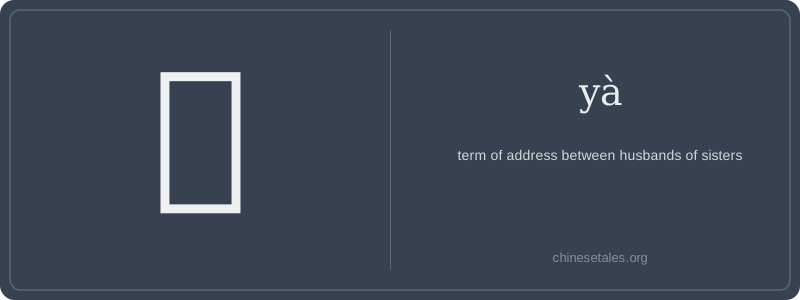
The earliest trace of 娅 appears not in oracle bones but in late Han dynasty bronze inscriptions and early dictionaries like the Shuōwén Jiězì (121 CE), where it’s analyzed as a phono-semantic compound: 女 (nǚ, 'woman') on the left provides the semantic field (kinship/family), while 亞 (yà, 'second', 'subordinate', 'next in rank') on the right gives both pronunciation and conceptual nuance — suggesting 'the second husband in the sister-pair arrangement', or 'one who stands beside (not above or below) in the marital hierarchy'. Visually, 亞 was originally a pictograph of a ritual altar with four legs and a central post — symbolizing order, rank, and symmetry — which perfectly mirrors the balanced, parallel nature of the 娅 relationship.
This meaning solidified during the Tang and Song dynasties, appearing in genealogical records and legal texts concerning dowry, inheritance, and marital obligations among elite families. Unlike generic terms like 连襟 (liánjīn, 'collar-and-cuff', i.e., brothers-in-law), 娅 carries an implicit expectation of equal status and mutual obligation — a subtle but powerful cultural weight embedded in its strokes. Its rarity today isn’t due to obsolescence, but to the decline of the very marriage practice it names: marrying sisters to brothers.
At first glance, 娅 looks like a gentle, feminine character — and it is! With its 女 (nǚ, 'woman') radical on the left, it immediately signals kinship, gender, and social relationship. But here’s the twist: 娅 doesn’t refer to a woman at all. It’s a rare, highly specific kinship term meaning 'husband of one’s sister' — i.e., your sister’s husband, *when you are also married to his sister*. So it’s reciprocal: if Li Wei marries Zhang Mei, and her sister Zhang Lan marries Wang Tao, then Li Wei and Wang Tao call each other 娅. Think of it as 'brother-in-law via double sister marriage' — a linguistic artifact of traditional Chinese extended-family marriage patterns.
Grammatically, 娅 is almost always used in direct address or reference within family contexts — never as a standalone noun like 'uncle' or 'cousin'. You’d say 'Lǐ Xiōng, nín hǎo!' (Li Brother, hello!) — but with 娅, it’s usually preceded by a surname or title: Wáng Yà or Zhāng Yà. Crucially, it’s *not* used for any brother-in-law — only this precise, symmetrical marital link. Learners often misapply it to regular brothers-in-law (which are 姐夫/妹夫 or 连襟), or confuse it with 姨 (aunt) due to the similar sound and 女 radical.
Culturally, 娅 reflects how deeply Chinese kinship terms encode relational symmetry and reciprocity — not just who someone *is*, but *how they connect two families*. It’s vanishingly rare in modern urban life (hence its absence from HSK), surviving mainly in rural oral usage or classical texts describing aristocratic marriage alliances. Its quiet specificity makes it a linguistic fossil — beautiful, precise, and quietly endangered.