婬
Character Story & Explanation
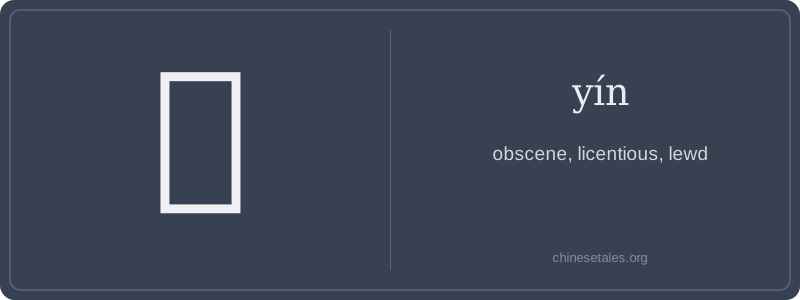
The earliest known form of 婬 appears in seal script (c. 3rd century BCE), evolving from the older character 淫 — which itself derived from the pictograph of 'water overflowing a riverbank' (the 氵 radical). But 婬 is a deliberate semantic twist: scribes replaced the water radical 氵 with the 'woman' radical 女 to signal that the 'overflowing' wasn't literal water — it was *unrestrained sexual desire*. The right side, 㸚 (yín), is a phonetic component borrowed from 易 (yì), but stylized with doubled 'sun' (日) elements — symbolizing excess, repetition, and unchecked intensity. Over centuries, the double 日 simplified into two parallel horizontal strokes above the 'X' shape, cementing the modern form where 女 + 㸚 visually shouts 'woman + excessive energy'.
This shift wasn’t arbitrary: during the Han dynasty, moral philosophers like Dong Zhongshu reinterpreted ancient flood metaphors as warnings against moral inundation. In the *Discourses on Salt and Iron* (盐铁论), officials condemned '淫佚之俗' — customs 'overflowing with decadence'. The character’s visual logic became its ethical argument: just as water must be channeled by dikes, desire must be bounded by ritual (li). Even today, the stroke order reinforces this — you write the 'woman' radical first, grounding the concept in human agency, then add the chaotic, doubling upper element — a calligraphy lesson in self-restraint.
At its core, 婬 (yín) carries a heavy, morally charged weight — it’s not just 'sexy' or 'flirtatious'; it’s explicitly *excessive*, *shameless*, and *morally transgressive* desire, especially in classical and legal contexts. Think less 'romantic tension' and more 'crossing a red line of propriety'. Unlike modern slang like 桃色 (táosè, 'pink/risqué'), 婬 is archaic, formal, and judgmental — you’ll find it in imperial edicts, Confucian moral critiques, or modern legal statutes condemning 'obscene conduct' (淫乱行为 yínluàn xíngwéi).
Grammatically, 婬 rarely stands alone as a verb. It’s almost always part of compound words: as the first character in disyllabic nouns/adjectives like 淫秽 (yínhuì, 'lewd/vulgar') or 淫荡 (yíndàng, 'licentious'), or fused into set phrases like 淫佚 (yínyì, 'debauched dissipation'). You won’t say '他很淫' — that’s ungrammatical and jarring. Instead, it modifies nouns ('淫行' yínxíng, 'lewd act') or pairs with verbs ('淫乱' yínluàn, 'to engage in lewdness'). Learners often misread it as 'yǐn' (like 饮) or confuse it with 易 (yì) — but its tone is firmly second, and its meaning is never neutral.
Culturally, 婬 reflects deep-rooted Confucian anxieties about social order: unregulated desire threatens family harmony, lineage purity, and state stability. That’s why it appears in ancient texts like the *Book of Rites* (礼记) condemning '淫声、淫色、淫志' ('lewd sounds, lewd appearances, lewd intentions'). Today, it survives mostly in formal writing, censorship law, and literary criticism — never in casual speech. Mistaking it for 淫 (a variant form) or overlooking its radical 女 (nǚ, 'woman') is common; that radical isn’t decorative — it signals this term historically pathologized *female*-coded desire (though modern usage applies it gender-neutrally to behavior).