婧
Character Story & Explanation
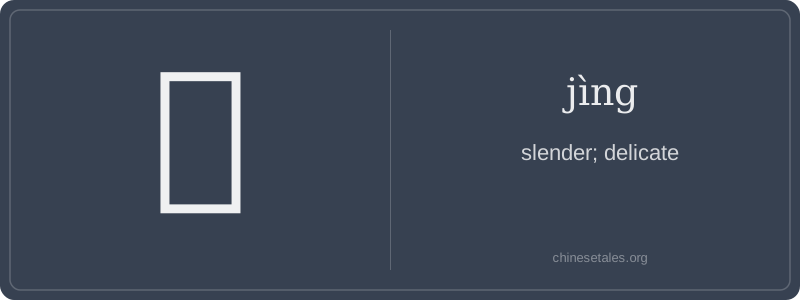
The earliest form of 婧 appears in seal script (c. 3rd century BCE), where it clearly combines the female radical 女 on the left with 青 (qīng, 'blue-green; youthful') on the right. Though no oracle bone form survives, bronze inscriptions show 女 + 青 evolving from a stylized depiction of a young woman with unbound hair and a slender silhouette — the 'blue-green' component wasn’t about color, but conveyed freshness, vitality, and unspoiled youth, like spring bamboo or jade’s cool luster.
By the Han dynasty, 婧 was codified in dictionaries like the Shuōwén Jiězì as 'a woman of talent and beauty' — linking physical delicacy to cultivated virtue. Classical poets used it sparingly: Li Bai’s disciple once described a scholar’s daughter as '婧然如兰' (delicately poised like an orchid), blending physical grace with scholarly refinement. Visually, the 11 strokes trace a harmony — three strokes for 女 (suggesting poised posture), eight for 青 (evoking upward growth and clarity) — making the whole character a miniature portrait of cultivated femininity.
婧 (jìng) is a graceful, poetic character — not for everyday speech but for names and literary description. Its core meaning 'slender; delicate' evokes elegance, refinement, and quiet poise: think willow branches bending in breeze, not frailty. Unlike common adjectives like 苗条 (miáotiáo) or 纤细 (xiānxì), 婧 carries classical weight and feminine dignity — it’s almost always used to praise a woman’s refined bearing or inner grace, never physical thinness alone.
Grammatically, 婧 functions almost exclusively as a noun modifier in compound names (e.g., 王婧, Lǐ Jìng) or as a standalone noun in literary phrases like ‘玉婧’ (jade-delicate one). You’ll rarely see it in predicative position ('She is 婧') — that would sound archaic or jarringly poetic. Learners often mistakenly try to use it like an adjective before nouns (e.g., *婧女孩), but native speakers say 婧的女孩 only in highly stylized contexts — usually it’s embedded in proper names or fixed epithets.
Culturally, 婧 belongs to the elegant ‘female virtue’ lexicon rooted in pre-Qin texts — it’s kin to characters like 娴 (xián, 'graceful composure') and 婉 (wǎn, 'gentle, restrained'). A subtle trap: its radical 女 doesn’t signal subordination here — rather, it elevates femininity as aesthetic and moral ideal. Confusingly, it shares pronunciation with 静 (jìng, 'quiet'), but they’re etymologically unrelated — a classic homophone pitfall for learners who rely on sound alone.