婢
Character Story & Explanation
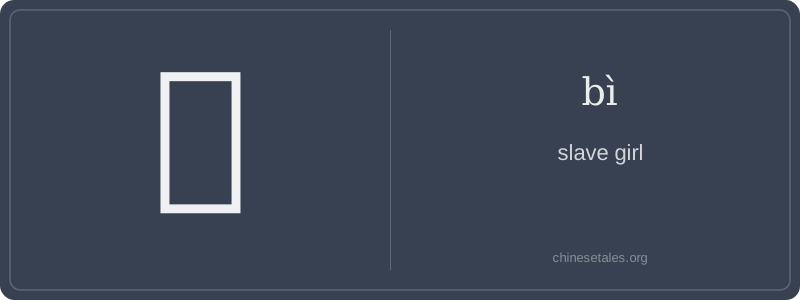
The earliest form of 婢 appears in Warring States bamboo slips — not as a pictograph, but as a phonosemantic compound already fully formed: 女 (nǚ, 'woman') on the left, indicating category, and 卑 (bēi, 'low, humble') on the right, providing both sound and meaning. 卑 itself evolved from an oracle bone glyph showing a person kneeling with hands bound — a visceral image of submission. Over centuries, 卑 simplified from ⿱丿卑 to its current shape, while 女 retained its graceful three-stroke silhouette. Stroke by stroke, the modern 婢 emerged: the first three strokes sketch the woman’s head and flowing hair (the dot, horizontal, and hook), then 卑’s compact structure — two short horizontals, a vertical, and a final falling stroke — visually ‘presses down’ on her identity.
In the Book of Rites (Lǐjì), 婢 appears alongside 奴 (nú, 'male slave') to codify household hierarchy — where a 婢’s testimony was inadmissible in court, and her children inherited her status. By Tang dynasty poetry, it acquired poetic resonance: Bai Juyi’s ‘Song of Everlasting Sorrow’ refers to imperial concubines’ attendants as 宫婢 (gōng bì), evoking quiet sorrow rather than mere labor. The character’s visual duality — feminine grace (女) fused with enforced lowliness (卑) — makes it one of Chinese writing’s most ethically charged compounds: beauty weaponized by power.
At its core, 婢 (bì) isn’t just ‘slave girl’ — it’s a linguistic fossil whispering about rigid pre-modern hierarchies. The character radiates social weight: not mere servitude, but *hereditary*, *gendered*, and *intimately domestic* bondage — think maids in aristocratic households who slept in corridors, handled private matters, and were often treated as extensions of the mistress’s will. You’ll almost never hear it in modern spoken Mandarin; it lives in classical texts, historical dramas, and literary criticism — always with a faint whiff of condescension or pathos.
Grammatically, 婢 functions exclusively as a noun, never as a verb or adjective. It rarely stands alone: you’ll see it in compounds like 使婢 (shǐ bì, 'attendant maid') or as part of respectful self-deprecation — e.g., a female scholar might call herself 小婢 (xiǎo bì, 'this humble maid') in a letter to a senior, echoing classical humility tropes. Learners mistakenly try to use it like 看护 (kānhù, 'caregiver') or 保姆 (bǎomǔ, 'nanny'), but those are neutral or even warm terms — 婢 carries irrevocable stigma and historical baggage.
Culturally, its power lies in what it omits: no mention of skill, loyalty, or personality — only status and subordination. That’s why modern writers use it sparingly, often ironically or critically (e.g., calling outdated gender roles 'spiritual 婢'). Confusing it with 姊 (zǐ, 'older sister') or 俾 (bǐ, 'to cause') is common — both look similar at a glance but belong to entirely different semantic universes. Remember: this character doesn’t describe a job. It describes a *place in the cosmic order* — and that place has no exit.