娸
Character Story & Explanation
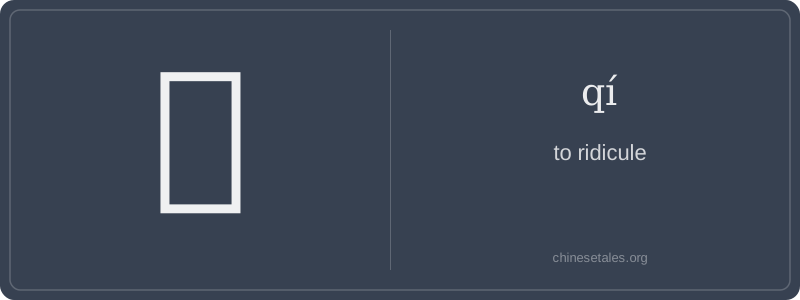
The earliest attested form of 娸 appears in late Warring States bamboo manuscripts, not oracle bones — and it’s a masterclass in visual irony. Its left side is 女 (nǚ, ‘woman’), a common radical for characters related to human behavior or social roles. Its right side is 其 (qí), originally a pictograph of a ritual wine vessel with a lid — later grammaticalized as a pronoun or particle. In 娸, however, 其 isn’t functioning grammatically; it’s acting as a phonetic loan (shēngpáng) that also hints at ‘that which is held up for scrutiny’. The character literally frames ‘a woman holding up something (or someone) for scorn’ — not as gendered insult, but as a metaphor for exposure and judgment.
By the Han dynasty, 娸 had solidified into its modern shape, appearing in texts like the *Shuōwén Jiězì* (c. 100 CE) as ‘to expose and mock what is false or unworthy’. It gained particular traction in Tang and Song dynasty literary criticism — poets like Bai Juyi used it to denounce hollow official rhetoric. The brilliance lies in how its components conspire: 女 suggests human agency and social performance; 其, sounding like qí, evokes both ‘this/that’ (pointing) and ‘qǐ’ (to lift — as in lifting up flaws to light). It’s not just ‘ridicule’ — it’s ‘ritualized exposure’.
At its heart, 娸 (qí) is a sharp, almost theatrical verb meaning 'to ridicule' — not just mild teasing, but pointed, often public mockery with a sting of contempt. Think of it as the linguistic equivalent of a raised eyebrow and a perfectly timed sigh: it carries judgment, social distance, and sometimes even moral disapproval. Unlike neutral synonyms like 讥 (jī) or 嘲 (cháo), 娸 implies deliberate, stylized derision — the kind you’d find in classical satire or a scholar’s biting commentary.
Grammatically, 娸 is transitive and almost always appears in formal or literary contexts: it takes a direct object (e.g., 娸人, 娸其无知), and rarely stands alone. You won’t hear it in casual chat — saying ‘他嘲笑我’ (tā cháoxiào wǒ) is natural; saying ‘他娸我’ sounds archaic or deliberately ironic, like quoting a Ming dynasty essayist. Learners often misread it as ‘qǐ’ (third tone) due to visual similarity with other characters — but it’s firmly qí (second tone), rhyming with ‘see’.
Culturally, 娸 evokes the Confucian ideal of restrained speech: ridiculing someone publicly violates rén (benevolence) and lǐ (ritual propriety). That’s why it appears most often in historical texts criticizing hypocrites or pretenders — never in self-deprecation. A classic mistake? Using it in spoken Mandarin thinking it’s a fancy synonym for ‘laugh at’. It isn’t — it’s a scalpel, not a chuckle.