娭
Character Story & Explanation
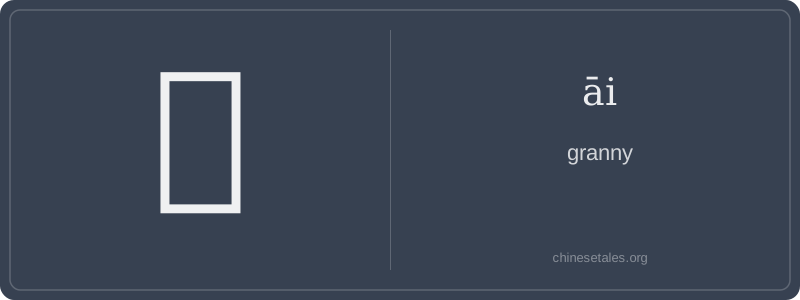
The earliest form of 娭 is not found in oracle bones — it’s a later dialectal creation, likely emerging during the late Ming or Qing dynasties as a phonetic-semantic compound. Visually, it merges the female radical 女 (suggesting gendered kinship) with the phonetic component 艾 (ài, 'mugwort'), which here provides the sound āi (via tone shift and dialectal simplification). Notice how the top part of 艾 — 艹 (grass) — was dropped, leaving just 爱 without the heart (心), then stylized into the modern upper right: 乂 + 一. So 娭 isn’t ancient pictography — it’s linguistic folk engineering: 'woman' + 'sound of ài → āi'.
This character never appeared in classical texts like the Analects or Dream of the Red Chamber — it’s a grassroots innovation. Its rise parallels the spread of Xiang dialect media and oral storytelling traditions in Hunan, where elders were addressed with intimate, melodic terms. Interestingly, 艾 (ài) itself symbolizes longevity and protection in Chinese culture (mugwort is used in moxibustion), so the phonetic choice subtly reinforces the nurturing, protective role of grandmothers — a poetic layer hiding in plain sight.
Meet 娭 (āi) — a warm, affectionate, and deeply regional word for 'granny', used almost exclusively in Hunanese dialects (especially Changsha speech) and some parts of Jiangxi. Unlike standard Mandarin’s 奶奶 (nǎinai) or 婆婆 (pópo), 娭 carries a folksy, tender, slightly rustic charm — like calling your grandmother 'Granny' instead of 'Grandma'. It’s not formal, not literary, and not found in textbooks — but it’s alive in kitchens, market stalls, and family phone calls across central-southern China.
Grammatically, 娭 functions as a standalone kinship noun, often preceded by a possessive pronoun: wǒ de āi (my granny), tāmen de āi (their granny). Crucially, it doesn’t take reduplication (no *āi āi) or honorific prefixes like 阿 (ā) — that’s reserved for characters like 阿姨 (āyí). Learners sometimes misread it as āi (like ‘ai’ in ‘aisle’) and confuse it with the interjection 唉 (āi, 'alas!') — but this 娭 has no sighing sorrow; it’s all softness and steamed buns.
Culturally, using 娭 signals deep local roots — it’s a linguistic handshake in Hunan. Outsiders who drop it unironically may raise eyebrows (or smiles!). And beware: writing it in formal documents or Beijing-based exams? It’ll be flagged as non-standard. Yet in a Changsha teahouse, saying 'Āi zài zuò shén me?' (What’s Granny doing?) earns instant warmth — and possibly a free cup of chrysanthemum tea.