娩
Character Story & Explanation
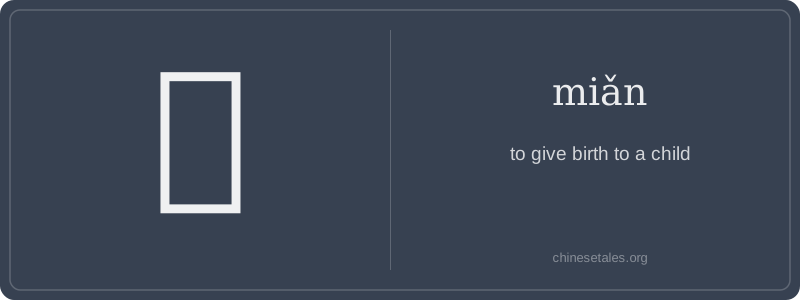
The earliest form of 娩 appears in Han dynasty clerical script, not oracle bones — because childbirth was rarely inscribed on ritual bronzes! Visually, it combines 女 (nǚ, 'woman') on the left with 免 (miǎn, 'to avoid, to exempt') on the right. That right side isn’t random: in ancient script, 免 depicted a person kneeling with arms raised — possibly symbolizing the act of pushing or releasing. Over centuries, the kneeling figure simplified into today’s 免, while the woman radical stayed firmly grounded on the left, anchoring the meaning in female embodiment.
By the Tang dynasty, 娩 had solidified as the standard term for ‘childbirth’ in medical writing, especially in texts discussing complications — its ‘exemption’ component subtly evoking the idea of *being freed from pregnancy*, or the infant *being exempted from the womb*. Classical poets avoided it (too clinical!), but Song dynasty physician Qian Yi used it precisely in pediatric treatises. The character’s visual duality — woman + release — remains uncannily accurate: ten strokes total, mirroring the approximate ten months of gestation, and the 免 radical even resembles an infant emerging head-first when rotated mentally.
Think of 娩 (miǎn) as Chinese’s elegant, one-syllable equivalent of 'to deliver' — not a package, but a baby. Unlike English verbs that often require auxiliaries ('is giving birth', 'gave birth'), 娩 stands powerfully alone: it’s almost always used in formal, medical, or literary contexts, never in casual speech (you’d say 生孩子 shēng háizi instead). It carries quiet gravity — like saying 'parturition' instead of 'having a baby'. Its tone (third tone) dips then rises, mirroring the physical effort and release of childbirth itself.
Grammatically, 娩 is typically transitive and appears in compound verbs or passive constructions: 顺产娩出 (shùn chǎn miǎn chū, 'delivered vaginally') or 被顺利娩出 (bèi shùn lì miǎn chū, 'was delivered smoothly'). Learners often mistakenly use it as a standalone verb like 'she 娩ed yesterday' — but native speakers *never* say that; it’s always embedded in a phrase. Also, don’t confuse it with 生 (shēng) — while both mean 'to give birth', 生 is colloquial and versatile; 娩 is clinical and precise.
Culturally, 娩 reflects how Chinese language reserves certain characters for moments of profound biological transition — like a linguistic scalpel reserved only for the delivery room. You’ll see it on hospital forms, obstetric textbooks, and classical medical texts (e.g., the Compendium of Materia Medica), but never in birthday cards. A common error? Pronouncing it as miàn (fourth tone) — remember: it’s miǎn, like 'mee-en' with a gentle dip, echoing the 'm' of 'mother' and the 'ian' of 'infant'.