娣
Character Story & Explanation
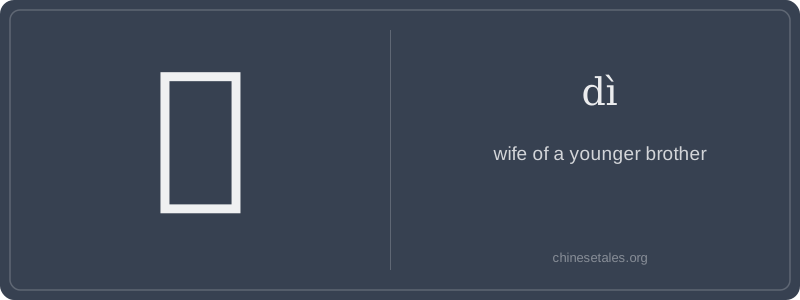
The earliest form of 娣 appears in bronze inscriptions from the Western Zhou dynasty (c. 1046–771 BCE), where it was written with the ‘woman’ radical 女 on the left and a phonetic component resembling ‘弟’ (dì, younger brother) on the right — already capturing its core idea. The modern shape stabilizes during the Han dynasty: 女 (3 strokes) + 弟 (7 strokes) = 10 strokes total. Crucially, 弟 itself evolved from a pictograph of tied-up bamboo shoots — symbolizing ‘younger growth’ — making 娣 a visual compound: ‘woman + younger brother’, literally ‘the woman belonging to the younger brother’.
This meaning crystallized in early texts like the *Book of Rites* (*Lǐjì*), where 娣 appears in discussions of marriage rituals among noble families: when a man married sisters, the younger sister who followed the elder as a secondary wife was called a 娣 — a usage that later broadened to include any younger brother’s wife. The character’s structure reinforces this logic: 女 anchors gender and role; 弟 anchors birth order and relational position. Even today, seeing those 10 strokes is like reading a mini-manual on hierarchical kinship — no explanation needed, just recognition.
娣 (dì) is a quietly precise term that reveals how deeply Chinese kinship language maps social hierarchy onto every relationship — not just by generation, but by birth order *within* a generation. It doesn’t mean ‘sister-in-law’ broadly; it means *only* the wife of your younger brother — a distinction so fine that English collapses it into one vague phrase. To native speakers, using 娣 signals awareness of subtle family positioning: you’re not just naming a relative, you’re acknowledging rank, respect, and even generational flow in the clan.
Grammatically, 娣 functions almost exclusively as a noun — rarely as a verb or modifier — and appears mainly in formal writing, classical allusions, or when describing traditional family structures. You won’t hear it in casual chat ('My brother’s wife is coming over!'), but you *will* see it in legal documents about inheritance, historical novels, or wedding invitations honoring elder/younger branch distinctions. A common learner mistake is overgeneralizing it to mean any sister-in-law — but that’s 嫂 (sǎo) for the elder brother’s wife, and 娣 only for the younger. Confusing them isn’t just inaccurate — it subtly misrepresents family seniority.
Culturally, 娣 reflects the Confucian principle of *zhǎng yòu yǒu xù* (senior and junior must have order). Its rarity today underscores shifting norms: as nuclear families replace multi-generational households, such finely graded kinship terms fade — yet they persist in literature and law, acting like linguistic fossils preserving an older social architecture. Learners who master 娣 aren’t just learning vocabulary — they’re reading a 2,500-year-old family tree.