娠
Character Story & Explanation
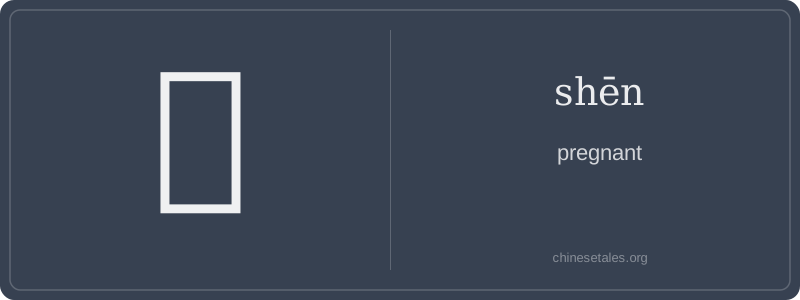
The earliest trace of 娠 appears in seal script (c. 3rd century BCE), where it already combines the 女 (nǚ, ‘woman’) radical on the left with 申 (shēn) on the right — no pictograph of a swollen belly or fetus. That’s key: unlike many pregnancy-related characters, 娠 was never pictographic. Instead, it’s phono-semantic: 女 signals the domain (female physiology), while 申 provides both sound and symbolic resonance — 申 originally depicted lightning bolts (a zigzag line), later evolving to mean ‘to extend’, ‘to declare’, or ‘to stretch out’. So visually, the character suggests a woman whose body is *extending*, *declaring itself* — not passively carrying, but actively unfolding new life.
This conceptual layer deepened in classical texts. In the *Huangdi Neijing* (Yellow Emperor’s Inner Canon, c. 2nd century BCE), 娠 appears alongside 產 (chǎn, ‘to give birth’) and 育 (yù, ‘to nurture’), forming a triad of life’s sacred phases: conception (娠), delivery (產), and upbringing (育). By the Tang dynasty, poets used 娠 metaphorically — Li Bai once wrote of ‘mountains in gestation’ (山娠雲氣), personifying nature’s fertile stillness. The ten strokes aren’t arbitrary: the four dots in 申 echo fetal movement; the smooth curve of 女’s skirt mirrors the rounding abdomen — a subtle calligraphy of becoming.
At its core, 娠 (shēn) isn’t just a clinical term for ‘pregnant’ — it’s a quiet, dignified word steeped in classical restraint. Unlike colloquial terms like 怀孕 (huái yùn), which literally means ‘to hold pregnancy’, 娠 appears almost exclusively in formal, literary, or medical contexts: official documents, classical poetry, or respectful speech about expectant mothers. It carries a subtle tone of reverence — as if acknowledging not just biological change, but the profound social and cosmic transition underway.
Grammatically, 娠 is almost never used alone. You’ll rarely hear ‘她娠了’ — that sounds archaic or jarringly stiff. Instead, it appears in compounds (like 妊娠) or with modifiers: 早孕期 (zǎo yùn qī, early pregnancy), or in passive constructions like 被诊断为妊娠 (bèi zhěn duàn wéi rèn shēn, ‘diagnosed as pregnant’). Learners often mistakenly treat it like a verb — but it functions more like a noun or nominal adjective, requiring supporting words to convey action or state.
Culturally, its rarity in daily speech reveals something beautiful: Chinese traditionally avoids blunt biological labels in polite discourse. Using 娠 signals intentionality — you’re choosing formality, sensitivity, or authority. A common mistake? Confusing it with similar-sounding shēn characters like 申 or 深 — but those lack the 女 radical, so they have nothing to do with womanhood or fertility. This character reminds us that in Chinese, even grammar is quietly gendered and culturally choreographed.