娜
Character Story & Explanation
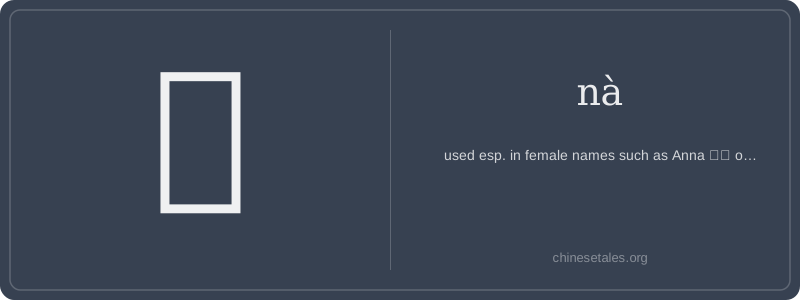
The character 娜 didn’t exist in oracle bone or bronze inscriptions — it’s a latecomer, invented during the Han dynasty or later by combining the ‘woman’ radical 女 with the phonetic component 那 (nà). Visually, it’s elegant simplicity: three strokes for 女 (the ‘legs’ and ‘arms’ of a kneeling woman), then six more for 那 — which itself evolved from a pictograph of a city gate with a flag, later repurposed purely for sound. No ancient scribe ever carved ‘娜’ into turtle shell; it was forged in the quiet workshop of transliteration, where scribes needed a character that sounded like ‘na’ *and* felt appropriately feminine.
Its semantic journey is pure linguistic alchemy: 那 originally meant ‘that’ (still does!), while 女 marked gender. Together, they created a new glyph with no classical meaning — until the 20th century, when translators seized it to render the final syllable of countless Western female names. Classical texts never use 娜 alone; you’ll find it only in modern novels, ID cards, and school rosters — a living fossil of cross-cultural naming, wearing the ancient robe of 女 but speaking in the accent of Berlin, Tokyo, and Buenos Aires.
Imagine you’re at a Shanghai university orientation, and a cheerful student introduces herself: ‘Nǐ hǎo! Wǒ jiào Lǐ Mǐnà!’ — her name ends with 娜. You notice instantly: every female classmate’s name seems to have this character — Xiǎonà, Yùnà, Jiānà — always at the end, never alone, never in verbs or nouns, never in textbooks. That’s your first clue: 娜 isn’t a word — it’s a phonetic ornament, a graceful suffix borrowed from foreign names to soften and feminize transliterations.
Grammatically, 娜 has zero independent meaning and appears only in proper nouns (almost exclusively female given names) or rare literary compounds like 婀娜 (ē nuó), where it’s part of a fixed two-character word meaning ‘graceful and supple’. Crucially, it’s never used alone: saying just ‘Nà’ without context sounds incomplete, like hearing only the last note of a melody. Learners often mistakenly try to use it as a standalone noun (‘She is a nà’) — but Chinese doesn’t work that way. It’s a syllable-carrier, not a semantic unit.
Culturally, its rise mirrors China’s modern engagement with global naming: Anna → Ānnà, Diana → Dài’ānnà. The character was chosen for its soft feminine radical (女) and pleasant sound — even though historically, it had nothing to do with Western names! And yes — it *can* be pronounced nuó (as in 婀娜), but that usage is poetic, archaic, and vanishingly rare outside set phrases. For 99% of encounters, think: ‘nà = name-ending sparkle’.