娀
Character Story & Explanation
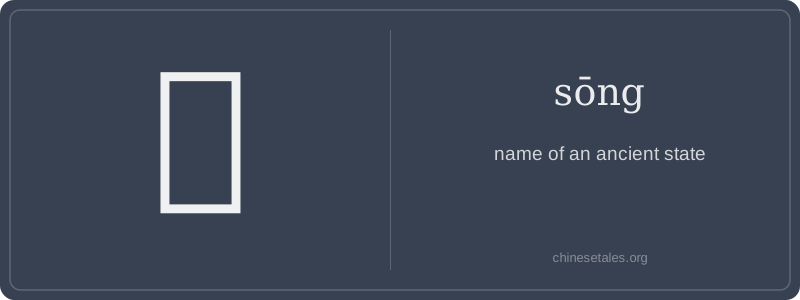
The earliest known form of 娀 appears on Western Zhou bronze vessels as a compound glyph: a simplified ‘female’ radical (女) fused with a phonetic element resembling ‘gong’ (工) or ‘song’ (松) — but crucially, *not* the modern pine tree character. Oracle bone script doesn’t preserve it, suggesting it emerged later, during the consolidation of regional states. Over centuries, the right-hand component streamlined from a multi-stroke ‘gong’-like shape into today’s ‘song’ (松), while the left ‘female’ radical remained stable — not for semantics, but because early scribes used female radicals for certain phonetic loans in state names (a quirk seen also in 姬 jī, 姜 jiāng).
By the Spring and Autumn period, 娀 referred specifically to a small vassal state located near modern-day Shangqiu in Henan — granted to descendants of the Shang royal house after their defeat by the Zhou. Confucius himself was said to be a descendant of the rulers of 娀, lending it quiet prestige in classical lore. Though the state vanished by the Warring States era, its name survived in texts like the Zuo Zhuan and Sima Qian’s Shiji, always marked by that distinctive ‘female + pine’ silhouette — a visual paradox where femininity anchors a martial, territorial identity.
Think of 娀 (sōng) as China’s version of 'Wakanda' — not a real place on modern maps, but a legendary, semi-mythical state that lives on only in ancient texts and scholarly footnotes. It carries zero grammatical weight in contemporary Mandarin: no verbs, no adjectives, no particles — just pure historical proper noun energy. You’ll never hear it in daily speech, order food with it, or text it to a friend. Its sole job is to whisper names from the Shang-Zhou twilight zone: kings who ruled forgotten valleys, bronze inscriptions buried for millennia, and genealogies scribbled by scribes with ink made from soot and ox bile.
Grammatically, 娀 behaves like any ancient state name — always capitalized in translation, always preceded by the classifier ‘the’ (though Chinese has no articles), and almost always paired with verbs like ‘ruled’, ‘conquered’, or ‘was enfeoffed by’. Example: ‘The Duke of Sōng governed the eastern marches.’ In Chinese, that’s just 娀 hóu zhì dōng yì — no particles needed, no tense markers. Learners sometimes try to force it into modern grammar (e.g., *wǒ shì sōng* — ‘I am Song’), but that’s like saying ‘I am Sparta’ in English — poetic, not literal.
Culturally, 娀 is a ghost character: visible only under academic UV light. Mistake it for the common surname 宋 (also sòng, but fourth tone!), and you’ve swapped a Bronze Age fiefdom for a Song Dynasty dynasty — a 1,000-year chronological leap! Also, don’t confuse its radical 女 (nǚ, ‘female’) with gender meaning here; it’s purely phonetic residue from an older form. This isn’t about women — it’s about geography fossilized in ink.