姺
Character Story & Explanation
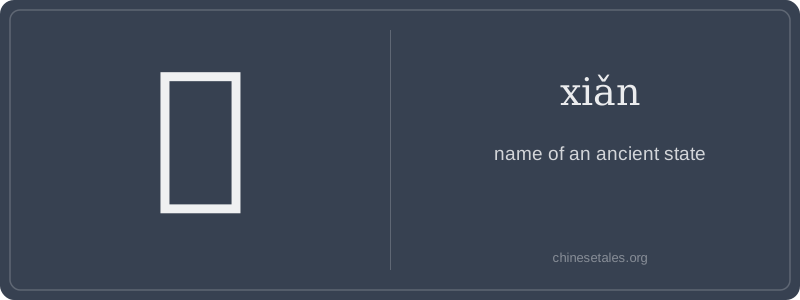
The earliest known form of 姺 appears on late Western Zhou bronze inscriptions — not oracle bones — as a compound glyph combining 女 (a kneeling woman, symbolizing lineage or clan identity) and 山 (a stylized mountain peak, likely indicating the state’s geographical setting among the Songshan foothills). In the bronze script, the 'woman' component was drawn with flowing, asymmetrical lines, while the 'mountain' had three jagged peaks — together forming a visual seal of territorial sovereignty. Over centuries, clerical script simplified the curves, and regular script standardized the two components into their modern stacked arrangement: 女 atop 山, with subtle hook adjustments for brush flow.
This character never evolved semantically — unlike most Chinese characters, it didn’t branch into verbs, adjectives, or abstract concepts. It remained rigidly topographic and political: a name, not a word. The *Zuo Zhuan* mentions the State of Xiǎn only once, in a footnote-like reference to its annexation by the State of Zheng. Its visual stability — unchanged for over 2,700 years — mirrors its function: a fixed marker on the map of Zhou-era power, preserved not by usage, but by reverence for ancestral records.
Here’s the truth no textbook will tell you: 姺 (xiǎn) isn’t a character you’ll ever need to write, read in modern texts, or use in conversation — it’s a linguistic fossil. It appears exclusively as the name of an ancient feudal state during the Western Zhou dynasty (c. 1046–771 BCE), located in present-day Henan Province. Its meaning is purely proper-nominal: it carries zero semantic weight beyond identifying that vanished polity. You won’t find it in dictionaries as a standalone word with definitions like 'peace' or 'river'; it exists only as a historical placename glyph.
Grammatically, 姺 functions solely as a proper noun — always capitalized in scholarly transliteration (e.g., the State of Xiǎn) and never used adjectivally, verbally, or in compounds outside rare bronze inscription transcriptions. Unlike common characters, it has no colloquial usage, no slang derivatives, and no verb forms. If you see it in a text, it’s almost certainly in an archaeological report, a bronze vessel inscription transcription, or a classical commentary on the *Zuo Zhuan*. Mistaking it for a functional character (e.g., confusing it with 鮮 xiān 'fresh') is a classic trap — but don’t worry: you’d have to be reading 3,000-year-old ritual bronzes to encounter it at all.
Culturally, 姺 is a quiet reminder that Chinese writing preserves political geography like geological strata: each obscure state-name character is a buried city-state, frozen in ink. Learners often overthink its 'radical' or stroke count — but here’s the kicker: 姺 has no standard radical classification in modern dictionaries because it’s so rare; some list it under 女 (nǚ, 'woman'), others under 山 (shān, 'mountain'), reflecting scholarly disagreement about its original component analysis. Its true home isn’t in grammar drills — it’s in museum archives and epigraphy labs.