姸
Character Story & Explanation
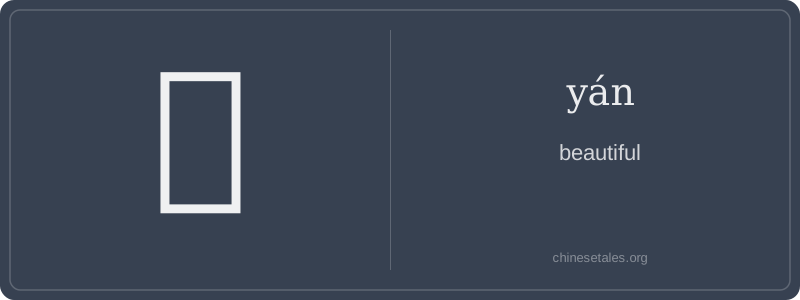
The earliest form of 姸 appears in seal script (around 3rd century BCE), combining the 'female' radical 女 on the left with 言 (yán, 'speech; words') on the right — not as a phonetic loan, but as a semantic-phonetic compound. The 'female' component grounds it in human aesthetics; 言 here isn’t about talking, but about 'manifesting presence' — like words giving form to thought. Over centuries, the right side simplified from full 言 (7 strokes) into the streamlined 7-stroke structure we see today, with clean horizontal strokes and a balanced, symmetrical frame — visually echoing the very harmony it describes.
In the Shuōwén Jiězì (121 CE), China’s first dictionary, 姸 is defined as '好也' ('good; fine'), emphasizing moral and aesthetic virtue intertwined. By the Tang and Song dynasties, poets like Li Qingzhao used 姸 to describe not just faces, but brushstrokes, garden pavilions, and even sorrow — proving its meaning expanded to 'aesthetic perfection in any refined domain'. Its visual symmetry — mirrored left-right balance, gentle curves — literally embodies the Confucian ideal of harmony (和, hé), making the character itself a miniature work of art.
At its heart, 姸 (yán) is a poetic, literary word for 'beautiful' — but not the everyday kind. Think of it as the Chinese equivalent of 'ethereal', 'graceful', or 'exquisitely refined'. It’s rarely used in casual speech or modern media; instead, it lives in classical poetry, calligraphy scrolls, and names (especially female given names like 姸妍 or 静姸), where it evokes delicate, understated elegance — more moonlight on water than neon lights. Unlike common synonyms like 美 (měi) or 漂亮 (piào liang), 姸 carries an almost tangible sense of harmony, balance, and quiet dignity.
Grammatically, 姸 functions almost exclusively as an adjective, but it’s highly constrained: you won’t say *'this dress is 姸'* in conversation. Instead, it appears in fixed, elegant phrases — often reduplicated (姸姸), paired with other literary adjectives (姸麗, 姸雅), or embedded in four-character idioms (姸媸畢露). It cannot take degree adverbs like 很 or 非常 — saying *'很姸'* sounds jarringly unnatural to native ears. Its syntax is ornamental, not descriptive.
Culturally, 姸 reflects a deep-rooted aesthetic ideal: beauty as inner resonance rather than surface appeal. Learners often mistakenly use it like a synonym for 美, leading to unintentionally archaic or even comical phrasing (e.g., calling a pizza '姸' would provoke polite confusion). Also, its radical 女 (nǚ, 'female') signals that traditional beauty ideals were gendered — yet today, its usage in names subtly subverts that, celebrating feminine strength through grace, not passivity.