姶
Character Story & Explanation
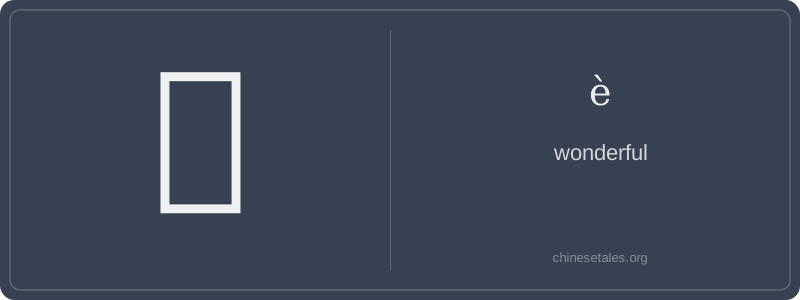
The earliest trace of 姶 appears not in oracle bones but in Warring States bamboo slips and early seal script, where it was written as 姶 — a combination of 女 (nǚ, 'woman') on the left and 宜 (yí, 'appropriate, fitting') on the right. The 'woman' radical wasn’t about gender per se; in ancient semantics, 女 often conveyed 'refinement,' 'receptivity,' or 'harmonious disposition' — think of how 妙 (miào, 'wonderful') and 姿 (zī, 'grace') also use 女. 宜 itself evolved from a pictograph of a meat offering placed correctly on an altar — symbolizing ritual propriety and perfect alignment. Over centuries, the seal form condensed: the top of 宜 simplified from ⺈+宀+且 to 亠+宀, and the lower part stabilized into 宜’s modern shape, yielding today’s 姶.
Its meaning crystallized during the Han dynasty in texts like the Shuōwén Jiězì, which defined it as 'the beauty of harmonious suitability' (和宜之美). Unlike 美 (which emphasizes sensory appeal) or 善 (shàn, 'morally good'), 姶 fused ethical order with aesthetic grace — the kind of excellence praised when a ruler’s decree matched the people’s needs *and* the season’s rhythm. In the Book of Rites, 姶 describes music that ‘settles the heart without excess’ — not loud or flashy, but deeply resonant. Its visual form — woman + fitting — thus embodies the ancient ideal: true wonder arises not from flash, but from flawless correspondence.
Think of 姶 (è) as Chinese poetry’s equivalent of the English interjection 'Ah!' — not a word you’d use in a grocery list, but one that bursts with aesthetic awe, like gasping at a perfectly composed haiku or a sudden sunset. It doesn’t mean 'wonderful' in the casual, thumbs-up sense ('great job!'), but rather 'exquisitely harmonious,' 'profoundly elegant,' or 'sublimely fitting' — a term reserved for moments where form, function, and feeling align with almost sacred precision.
Grammatically, 姶 is nearly extinct in modern spoken Mandarin — it appears almost exclusively in classical allusions, literary criticism, or highly stylized set phrases (e.g., 姶然, è rán). You won’t say 'This coffee is 姶' — it’s not an adjective you predicate with 是 or modify nouns directly. Instead, it functions adverbially or as a standalone exclamatory particle in poetic contexts: 姶哉!(è zāi!) — 'How exquisite!' — echoing the classical exclamation marker 哉. Learners often mistakenly treat it like a common adjective and try to slot it into everyday sentences, which sounds jarringly archaic or even comical.
Culturally, 姶 carries the quiet weight of Confucian aesthetics: harmony (和), appropriateness (宜), and refined resonance (韻). It’s the character you’d find in Song dynasty connoisseurs’ notes on ink-wash painting or Ming garden design manuals — praising how a rock placement 'accords with the mountain’s spirit.' Mistake it for common synonyms like 美 (měi) or 好 (hǎo), and you’ll miss its rarefied, almost ritualistic reverence for structural elegance.