姮
Character Story & Explanation
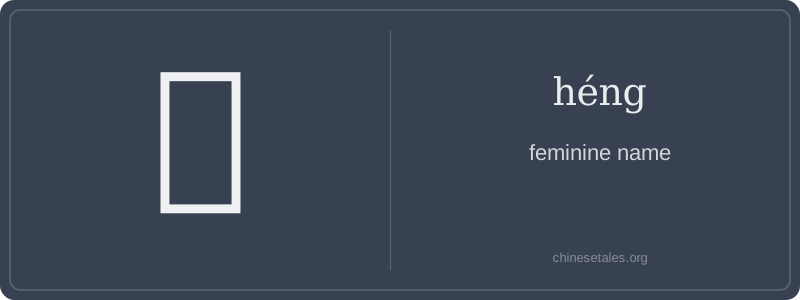
The earliest trace of 姮 isn’t in oracle bones — it’s a late Han dynasty innovation, born from calligraphic stylization. Visually, it fuses 女 (nǚ, 'woman') on the left — three strokes forming a kneeling figure with flowing hair — and 亘 (gèn, archaic variant of 恒, meaning 'to continue unceasingly') on the right. But here’s the twist: 亘 itself evolved from a pictograph of a horizontal line stretching across time — like the Milky Way arcing over the night sky. Over centuries, scribes simplified 亘’s top stroke and rounded its curves, yielding the elegant, balanced right-hand component we see today: six strokes mirroring the steady rhythm of celestial motion.
This fusion wasn’t accidental. In the Eastern Han text Shuōwén Jiězì, 姮 appears as a phonetic-semantic compound: 女 signals gender domain; 亘 provides both sound (héng) and subtle connotation — not 'eternity' per se, but *unbroken luminosity*, like moonlight uninterrupted by cloud. By Tang dynasty poetry, 姮 became synonymous with lunar grace, appearing in rare epithets for goddesses and virtuous women. Its visual harmony — 4+5 strokes echoing yin-yang balance — reinforced its association with refined, quiet strength — never force, always radiance.
Imagine you’re at a Beijing teahouse, listening to an elderly storyteller recount the legend of Chang’e — but wait, he pauses and says, 'Actually, her original name was Héng’é… and that first character? 姮 — not the more common 恒 or 衡.' That’s your first clue: 姮 is *exclusively* a feminine given-name character, shimmering with poetic antiquity. It carries no dictionary definition beyond naming — no verbs, no adjectives, no standalone meaning. You’ll never see it in a textbook sentence like 'She runs fast' — only in names like 姮玥 (Héngyuè) or 姮萱 (Héngxuān), where it lends elegance, softness, and classical resonance.
Grammatically, 姮 functions only as part of a two-character personal name — never alone, never as a surname, never in compounds outside names. Learners sometimes misread it as 恒 (héng, 'eternal') due to identical pronunciation and similar stroke count, but inserting 姮 into a phrase like '恒心' would be like writing 'Eternity-Heart' with a moon goddess’s name — grammatically invalid and culturally jarring. It appears almost exclusively in modern female names inspired by classical poetry or mythological refinement, often paired with characters evoking brightness, grace, or celestial imagery.
Culturally, 姮 is a quiet rebellion against linguistic efficiency: it survives not because it’s useful, but because it’s beautiful. Parents choose it to evoke Chang’e’s serene mystique — not her loneliness, but her luminous stillness. A common mistake? Assuming tone or context can 'unlock' a hidden meaning — but no: 姮 has *no* semantic payload outside naming. Its power lies precisely in its emptiness — a vessel for intention, not information.