姬
Character Story & Explanation
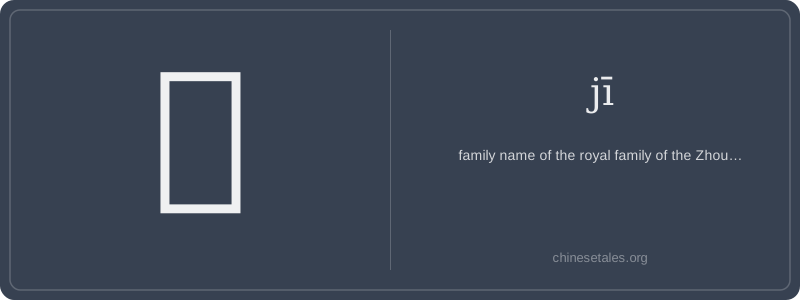
The earliest form of 姬 appears on Western Zhou bronze inscriptions as a composite: a kneeling woman (the ancient form of 女, with bent knees and hands clasped) beside a phonetic component resembling 台 (tái), which later simplified to 己. Over centuries, the woman radical stabilized into its modern upright form, while the right side evolved from 台 → 已 → 己 — a classic case of phonetic drift where pronunciation (jī) stayed constant but the written cue morphed. By the Han dynasty, the ten-stroke structure was fixed: three strokes for 女 (撇、撇点、横) plus seven for 己 (横折、横、竖弯钩, then the two dots above).
This character’s meaning didn’t wander — it stayed fiercely loyal to its origin. In the Shijing (Book of Odes), ‘Jī’ appears over 20 times referring exclusively to Zhou royal consorts and daughters, like the legendary Lady Jiang (Ji Jiang), wife of King Wen. The visual pairing of 女 + 己 isn’t arbitrary: 己 was both a phonetic anchor and a symbol of selfhood and lineage — suggesting ‘a woman whose identity is defined by her clan’. No other character so elegantly fuses sound, status, and gendered political power in one compact glyph.
Imagine you’re reading a Tang dynasty poem where the poet sighs, ‘Yíng yíng jī zǐ, shuāng bìn yǐ chéng shuāng’ — ‘That graceful lady of the Ji clan, now her temples silvered with age.’ Here, 姬 isn’t just a surname: it’s a whisper of Zhou dynasty royalty, carrying the quiet dignity of women who married kings, advised dukes, and bore heirs to the Mandate of Heaven. In classical Chinese, 姬 functions primarily as a proper noun — almost always a family name (like ‘Smith’ but with imperial pedigree) or an honorific title for noblewomen (e.g., ‘Lady Ji’). You’ll never see it as a verb or adjective; it’s grammatically inert but culturally loaded.
Modern usage is rare and highly stylized: it appears in historical novels, opera titles (e.g., 西施姬), or poetic surnames — never in daily speech like ‘Wang’ or ‘Li’. Learners often mistakenly treat 姬 as a generic word for ‘woman’ (since it contains 女), but that’s dangerously wrong: 女子 means ‘woman’, while 姬 *only* evokes aristocratic lineage. Confusing them is like calling Queen Elizabeth ‘Ms. Tudor’ — historically inaccurate and socially tone-deaf.
Culturally, 姬 anchors the ‘Eight Great Surnames of Antiquity’ — the eight founding clans of Zhou civilization. Its radical 女 reflects how early Chinese kinship traced legitimacy through maternal lines in elite marriage alliances. Today, seeing 姬 on a tomb inscription or in a genealogy scroll signals not just ancestry, but participation in the ritual-political architecture of China’s first golden age.